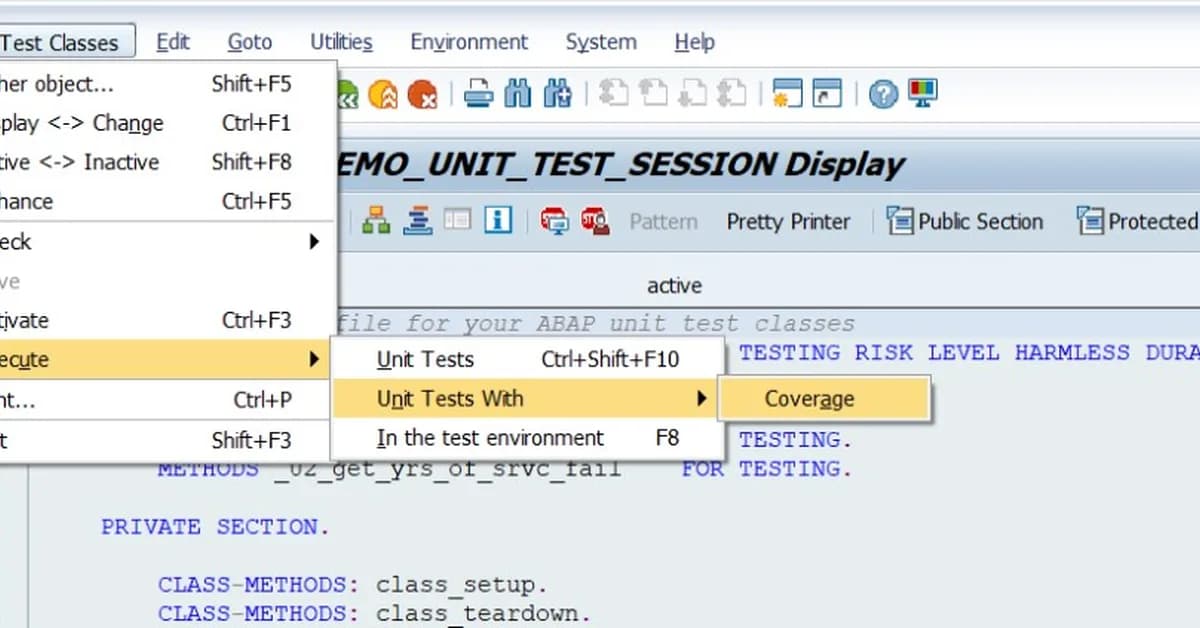
ABAP Test Seams are a powerful feature that allows you to replace specific parts of your ABAP code with alternative implementations during testing. This is particularly useful when dealing with legacy systems where the original code wasn't designed for testability or modularity.
Here's how you can use ABAP Test Seams:
- Define a Test Seam: You define a test seam by specifying which method should be replaced and what replacement method to use.
- Implement Replacement Methods: Write methods that will serve as the replacements during testing.
- Activate Test Seams in Tests: Use the
TEST_SEAMSstatement or thecl_abap_unit_assert=>set_test_seammethod to activate your test seams.
Example: Replacing a Method with a Mock
Let's say you have an existing class CL_LEGACY_CODE that contains a method GET_DATA_FROM_DATABASE. This method is hard-coded and difficult to replace for testing purposes. You can create a test seam to override this method during tests.
Step 1: Define the Test Seam
In your unit test, define the test seam:
abap1TEST_SEAMS( 'CL_LEGACY_CODE' => 'GET_DATA_FROM_DATABASE' 2 ' 3 4[Read the full article at DEV Community](https://dev.to/oktay_a56a5e9cc26cc1df8fe/abap-unit-testing-in-sap-s4hana-part-2-test-doubles-dependency-injection-and-mocking-2opd) 5 6--- 7 8**Want to create content about this topic?** [Use Nemati AI tools](https://nemati.ai) to generate articles, social posts, and more.
5
Contents

Ali NematiWritten by Ali
![[AINews] The Unreasonable Effectiveness of Closing the Loop](/_next/image?url=https%3A%2F%2Fmedia.nemati.ai%2Fmedia%2Fblog%2Fimages%2Farticles%2F600e22851bc7453b.webp&w=3840&q=75)