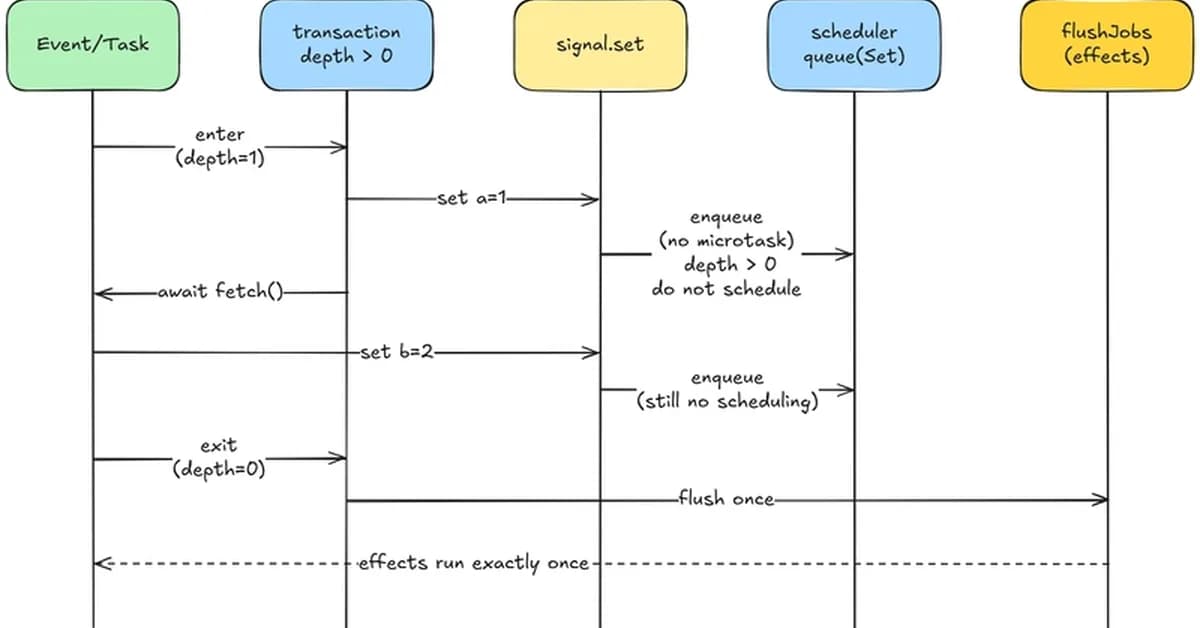
The provided code snippets demonstrate how to handle multi-step updates across await operations in React and Vue using a custom signal system. This approach ensures that UI transitions are smooth by deferring less urgent state updates until the more critical ones have completed.
Multi-Step Updates Across await in React
In React, you can use the startTransition function to defer non-critical state updates when dealing with asynchronous operations. Here's how it works:
- Define Signals and Hooks: Use a custom signal system (
signal,useSignalRef) to manage state. - Transaction Management: Wrap multi-step data updates in an
async transaction.
Example Code
javascript1import { signal, useSignalRef } from './react-adapter'; 2 3// Define signals for state management 4const a = signal(0); 5const b = signal(0); 6 7export function Counter() { 8 const va = useSignalRef(a); // React ref to the signal value 9 const vb = useSignalRef(b); // React ref to the signal value 10 11 async function run() { 12 await transaction(async () => { 13 a.set(va.value + 1); 14 await new Promise(resolve => setTimeout(resolve, 200 15 16[Read the full article at DEV Community](https://dev.to/luciano0322/async-transactions-for-signals-batching-updates-across-await-32hj) 17 18--- 19 20**Want to create content about this topic?** [Use Nemati AI tools](https://nemati.ai) to generate articles, social posts, and more.
2
Contents

Ali NematiWritten by Ali
![[AINews] The Unreasonable Effectiveness of Closing the Loop](/_next/image?url=https%3A%2F%2Fmedia.nemati.ai%2Fmedia%2Fblog%2Fimages%2Farticles%2F600e22851bc7453b.webp&w=3840&q=75)