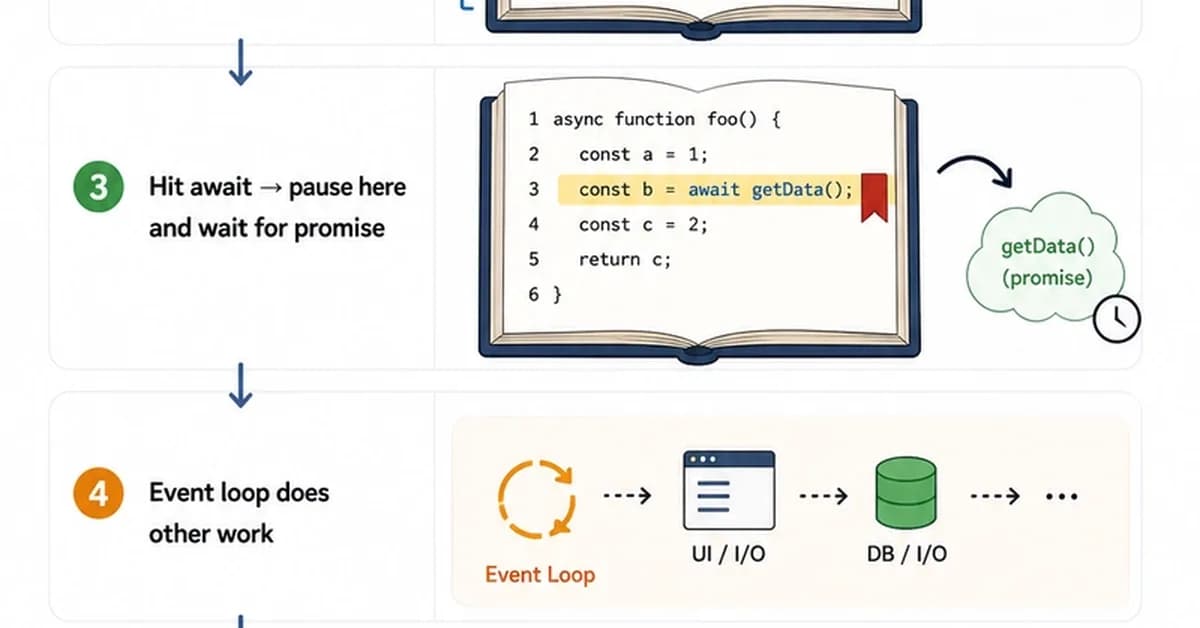
The provided text discusses the benefits and common pitfalls of using async/await in JavaScript for handling asynchronous operations. Here's a summary of key points:
Key Points
Benefits of Async/Await:
- Readability: Code written with async/await is easier to read and understand compared to chaining promises.
- Error Handling: It allows the use of standard
try...catchblocks for error handling, making it more intuitive than.catch()in promise chains. - Debugging: Provides clearer stack traces and makes debugging asynchronous code more straightforward.
- Intermediate Values: Variables can be assigned values directly within the function scope without needing to pass them through callbacks or promises.
- Conditional Logic: Enables cleaner, non-nested conditional statements compared to chaining promises.
Common Pitfalls:
- Using
awaitOutside an Async Function: This will result in a syntax error unless you use an Immediately Invoked Function Expression (IIFE) or top-level await in modules. - Uncaught Rejections: If an async function's promise is not handled with
.catch()ortry...catch, any rejected promises will go unhandled, potentially leading to hidden bugs. - **
Read the full article at DEV Community
Want to create content about this topic? Use Nemati AI tools to generate articles, social posts, and more.
4
Contents

Ali NematiWritten by Ali
![[AINews] The Unreasonable Effectiveness of Closing the Loop](/_next/image?url=https%3A%2F%2Fmedia.nemati.ai%2Fmedia%2Fblog%2Fimages%2Farticles%2F600e22851bc7453b.webp&w=3840&q=75)