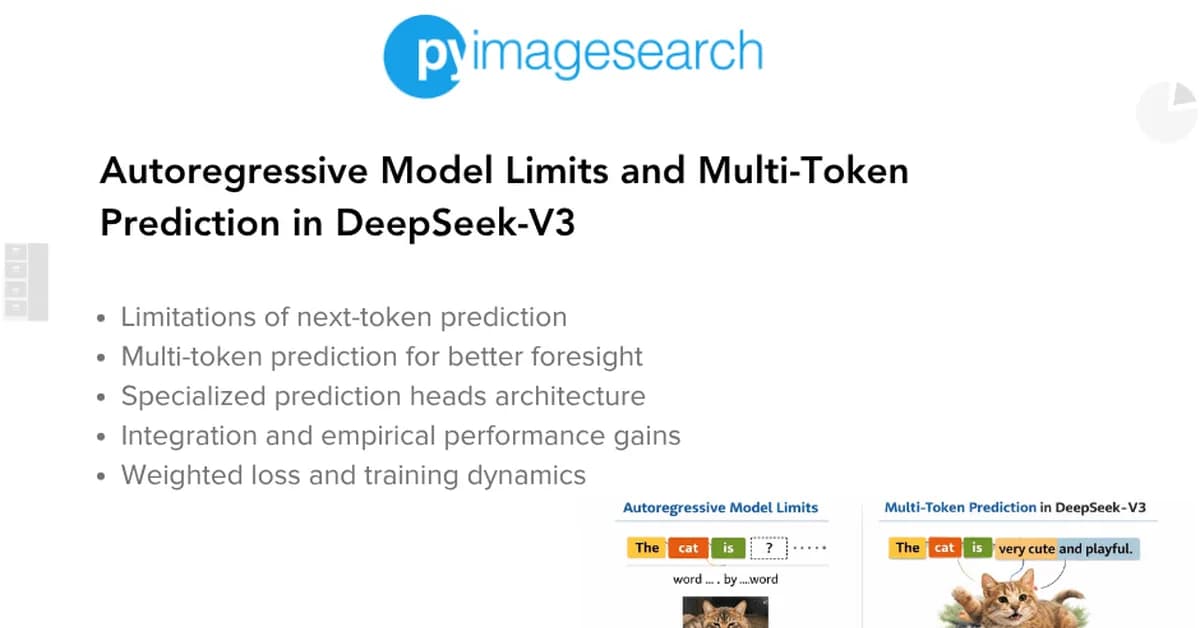
The concept of Multi-Token Prediction (MTP) in language models like DeepSeek-V3 introduces an innovative training strategy that enhances model performance by encouraging it to consider future tokens during the learning process, without affecting inference efficiency. Here's a detailed breakdown:
Core Idea
Multi-Token Prediction involves training the model not just to predict the next token but also several steps ahead. This is achieved through additional prediction heads (referred to as "MTP heads") that are trained alongside the main autoregressive head.
Training Phase
- Main Head: Predicts the immediate next token.
- Depth-1 Head: Predicts two tokens ahead from the current position.
- Depth-2 Head: Predicts three tokens ahead, and so forth.
Each MTP head uses a smaller version of the model's architecture (e.g., a shallow transformer) to predict further into the sequence. During training, these heads receive ground truth intermediate tokens as inputs, ensuring there is no error accumulation.
Loss Function
The loss function for MTP incorporates contributions from both the main prediction and the multi-step predictions:
[ \text{Total Loss} = L_{\text{main}} + \sum_d \lambda_d \cdot L_d \
Read the full article at Blog - PyImageSearch
Want to create content about this topic? Use Nemati AI tools to generate articles, social posts, and more.

![[AINews] The Unreasonable Effectiveness of Closing the Loop](/_next/image?url=https%3A%2F%2Fmedia.nemati.ai%2Fmedia%2Fblog%2Fimages%2Farticles%2F600e22851bc7453b.webp&w=3840&q=75)