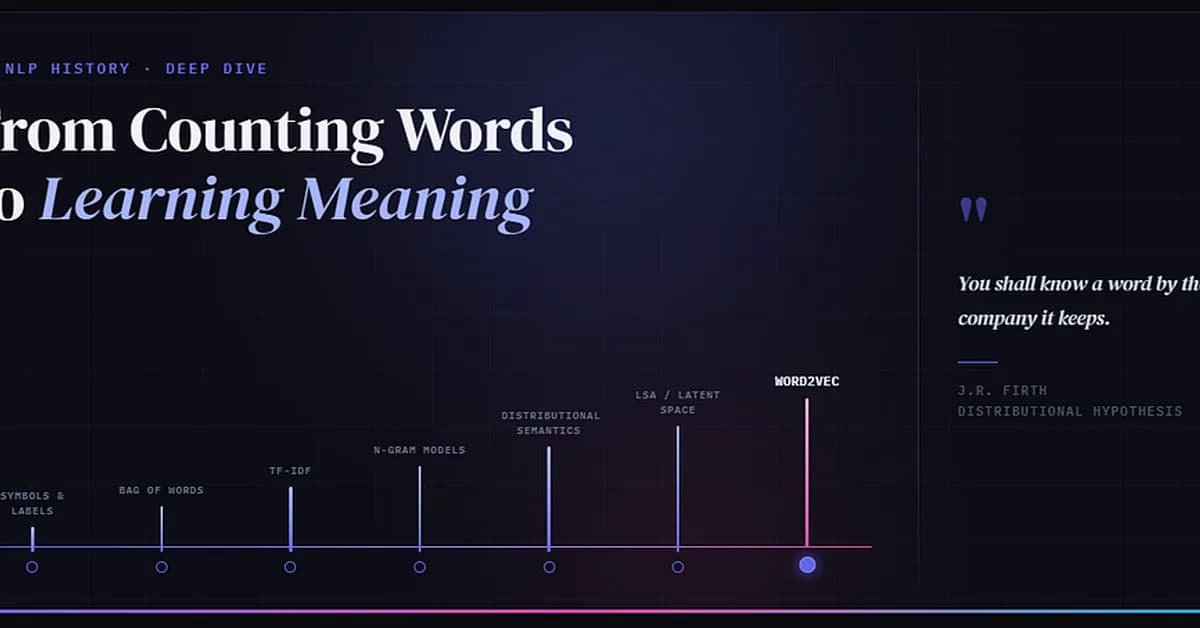
The journey of natural language processing (NLP) towards understanding meaning in text has been a series of incremental yet profound steps. Initially, words were treated as mere labels or counts within documents. Over time, researchers realized that the context surrounding words and their predictive relationships held deeper insights into their meanings.
Bag-of-words models taught NLP to count word occurrences, while TF-IDF introduced weighting based on relevance. These methods laid the groundwork for understanding document content but lacked nuance in capturing semantic similarity between words. As research progressed, techniques like co-occurrence matrices and distributional semantics started exploring how words gain meaning through their contextual usage.
Latent Semantic Analysis (LSA) and Latent Semantic Indexing (LSI) further advanced this by compressing large sparse count structures into smaller latent spaces, hinting at the idea that deeper meanings might reside in lower-dimensional hidden structures. This intuition paved the way for neural language models which introduced learnable internal representations capable of generalizing beyond exact counts.
The advent of Word2Vec marked a significant milestone by integrating these older intuitions into a cohesive framework where word vectors are learned through predictive relationships within context, effectively positioning words as points in a learned relational space. This shift not only simplified the representation
Read the full article at Towards AI - Medium
Want to create content about this topic? Use Nemati AI tools to generate articles, social posts, and more.

![[AINews] The Unreasonable Effectiveness of Closing the Loop](/_next/image?url=https%3A%2F%2Fmedia.nemati.ai%2Fmedia%2Fblog%2Fimages%2Farticles%2F600e22851bc7453b.webp&w=3840&q=75)