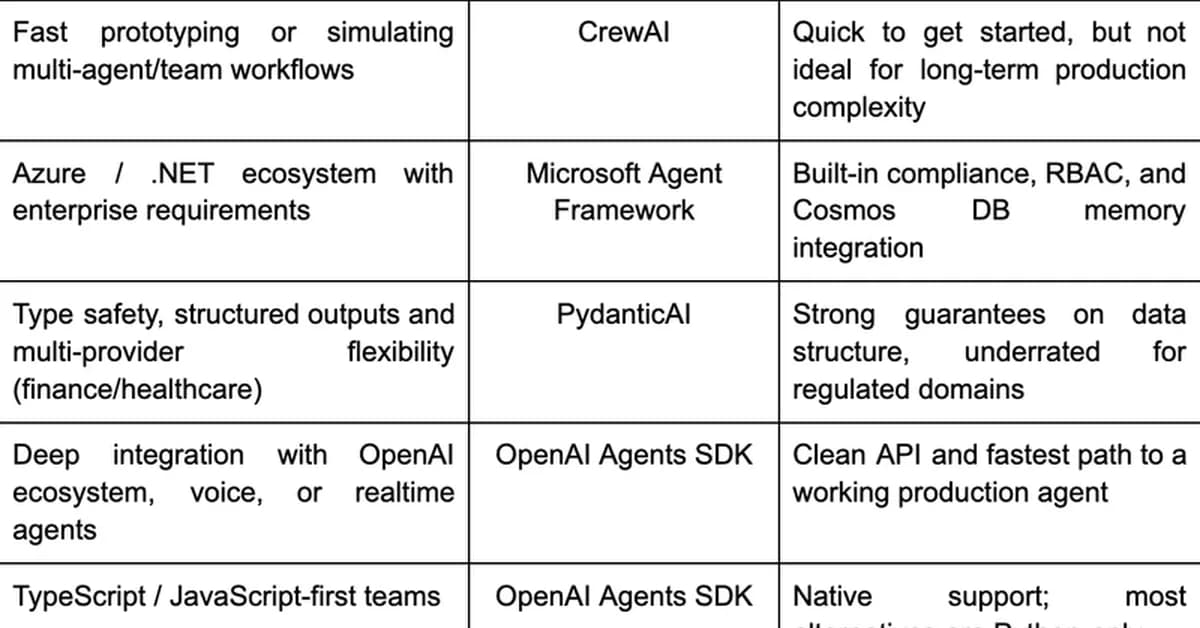
Based on your detailed comparison of various agent frameworks for building conversational AI applications, here's a summary highlighting key strengths and use cases for each:
-
LangGraph (LlamaIndex)
- Strengths:
- Highly modular and flexible.
- Excellent for complex multi-agent systems with intricate memory management.
- Supports a wide range of LLM providers and vector stores.
- Use Cases:
- Complex conversational agents requiring sophisticated memory handling.
- Multi-agent collaboration scenarios.
- Strengths:
-
Microsoft Agent Framework
- Strengths:
- Deep Azure integration, including enterprise-grade security and compliance features.
- Supports both Python and .NET ecosystems.
- Robust multi-agent conversation patterns inherited from AutoGen.
- Use Cases:
- Enterprise applications within the Azure ecosystem requiring strong security and compliance.
- Multi-agent systems with complex collaboration needs.
- Strengths:
-
PydanticAI
- Strengths:
- Strong type safety and validation, reducing runtime errors.
- Highly flexible and ergonomic design, similar to FastAPI.
- Supports a wide range of LLM providers out-of-the-box.
- Use Cases:
- Strengths:
Read the full article at DEV Community
Want to create content about this topic? Use Nemati AI tools to generate articles, social posts, and more.
2
Tags

Ali NematiWritten by Ali
![[AINews] The Unreasonable Effectiveness of Closing the Loop](/_next/image?url=https%3A%2F%2Fmedia.nemati.ai%2Fmedia%2Fblog%2Fimages%2Farticles%2F600e22851bc7453b.webp&w=3840&q=75)