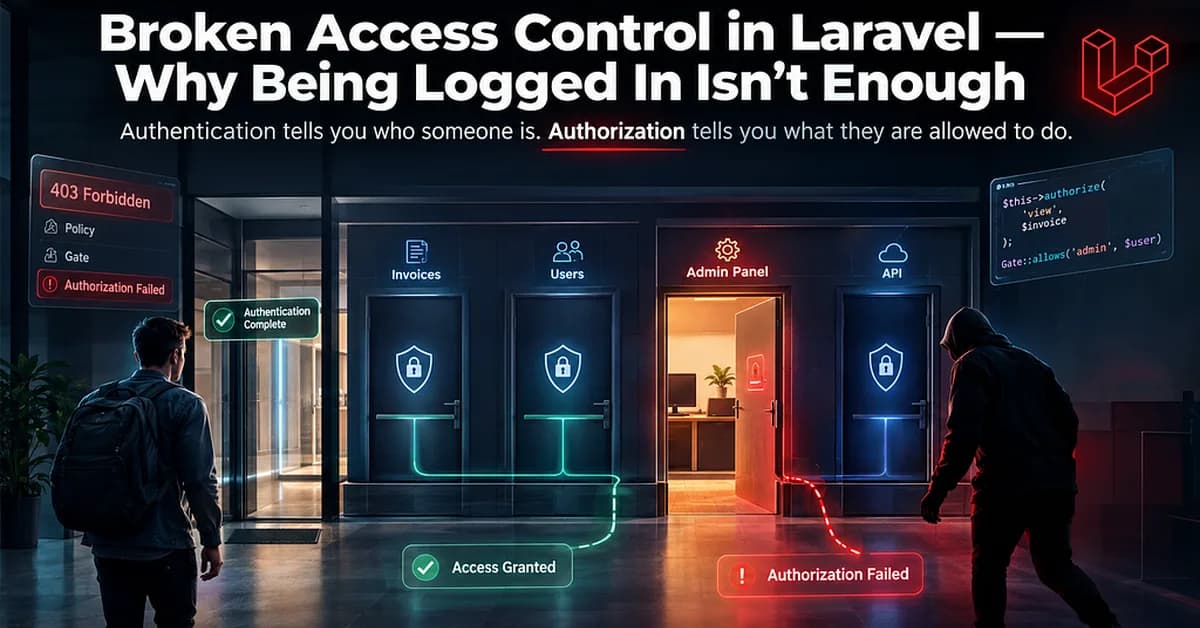
The article "Broken Access Control in Laravel — Why Being Logged In Isn't Enough" delves into a critical security issue within web applications built using Laravel. It explains that simply being authenticated does not guarantee authorization for accessing specific resources or performing certain actions, which is the core of broken access control vulnerabilities.
Key Points:
-
Authentication vs Authorization:
- Authentication verifies user identity.
- Authorization ensures users can only perform actions they are permitted to do based on their role and permissions.
-
Common Vulnerability Scenarios:
- Attackers may try to manipulate URLs or use brute force techniques to access unauthorized resources.
- Even if a request looks legitimate, it might still be an attempt to exploit access control weaknesses.
-
Laravel's Built-in Features for Authorization:
- Policies: Define rules for specific actions (e.g.,
view,update,delete) on models likeInvoice.php1public function view(User $user, Invoice $invoice): bool 2{ 3 return $user->id === $invoice->user_id; 4} 5 6public function update(User $user, Invoice $invoice): bool 7{ 8 return $user->
- Policies: Define rules for specific actions (e.g.,
Read the full article at System Weakness - Medium
Want to create content about this topic? Use Nemati AI tools to generate articles, social posts, and more.
Views12
On this page

Ali NematiBlogUI.author_articles