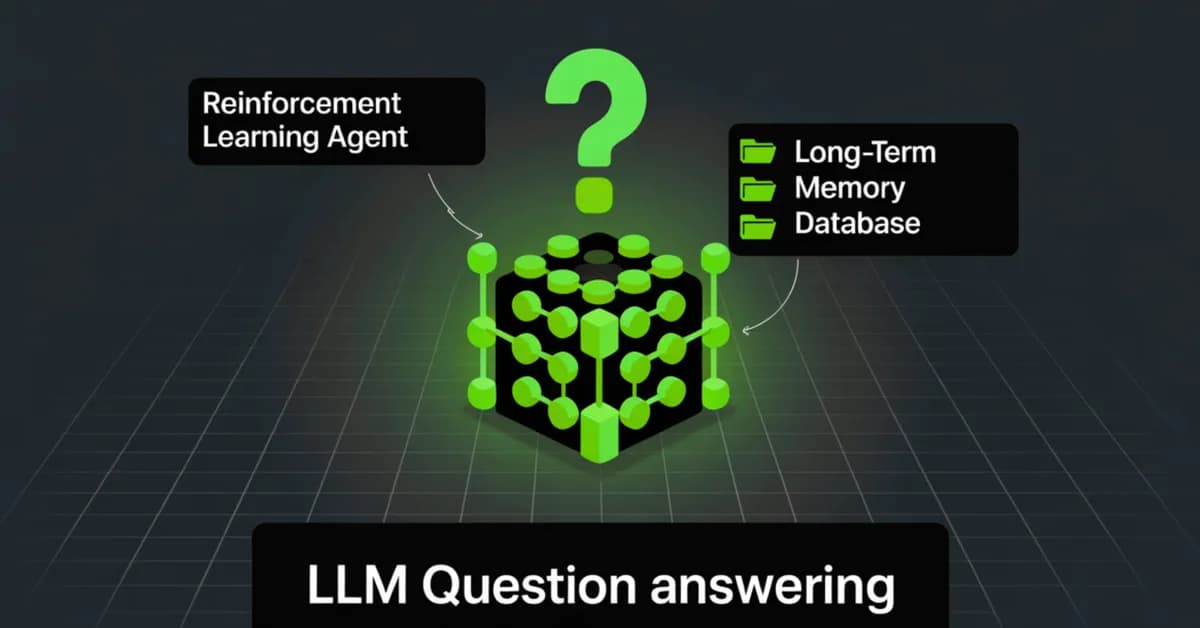
The code you've provided is a comprehensive example of how to build and evaluate a reinforcement learning (RL) agent for the task of memory retrieval. The goal is to train an RL agent that can select the most relevant memory from a set of candidates to answer a given query, outperforming a baseline cosine similarity approach.
Here's a breakdown of what each part of the code does:
1. Environment Setup and Candidate Preparation
- Embeddings: You start by preparing embeddings for both queries and candidate memories using an embedding model (e.g.,
sentence-transformers). - Candidate Memories: For each query, you compute similarity scores between the query and all candidate memories to rank them.
- Features Extraction: Each candidate memory is described with features such as cosine similarity, keyword overlap, entity matching, and more. These features are used by the RL agent to make decisions.
2. Reinforcement Learning Environment
- MemoryRetrievalEnv Class: This class defines a custom Gym environment for training an RL agent. The environment provides observations (features of candidate memories) and rewards based on how well the selected memory matches the query.
- Training Setup: You split your dataset into train, validation, and test sets
Read the full article at MarkTechPost
Want to create content about this topic? Use Nemati AI tools to generate articles, social posts, and more.
2
Contents

Ali NematiWritten by Ali
![[AINews] The Unreasonable Effectiveness of Closing the Loop](/_next/image?url=https%3A%2F%2Fmedia.nemati.ai%2Fmedia%2Fblog%2Fimages%2Farticles%2F600e22851bc7453b.webp&w=3840&q=75)