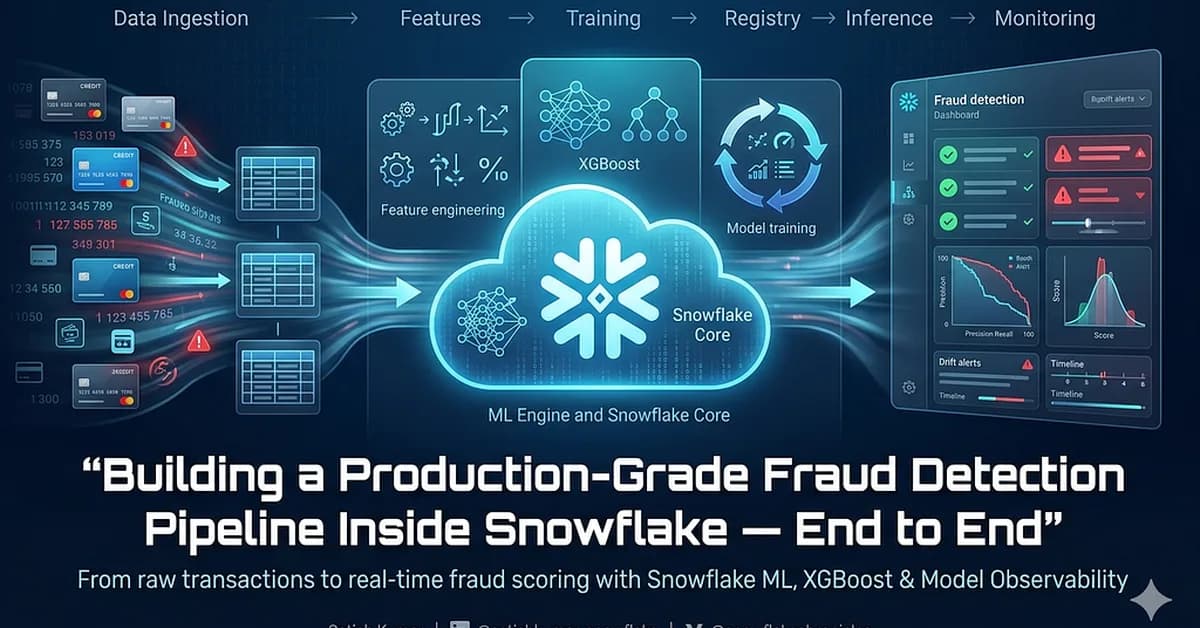
It looks like you've completed a comprehensive fraud detection model development workflow using Snowflake's ML capabilities. Here’s a summary of the key steps and what each step accomplishes:
-
Data Preparation:
- Loaded data from Snowflake tables into pandas DataFrames.
- Applied feature engineering to create new features such as
AMOUNT_TO_AVG_RATIO,IS_HIGH_RISK_HOUR,RISK_COMPOSITE,LOG_AMOUNT, andCREDIT_SCORE_BIN.
-
Model Training & Evaluation:
- Trained an XGBoost model on the engineered dataset.
- Evaluated the model using metrics like ROC AUC, average precision, and F1 score.
-
Threshold Optimization:
- Conducted a threshold sweep to find the optimal balance between precision and recall based on business needs (e.g., minimizing false negatives while controlling false positives).
-
Model Registration:
- Registered the trained model in Snowflake's Model Registry.
- Logged metadata, sample input data, metrics, and version information.
-
Batch Inference:
- Applied the same feature engineering pipeline to new transaction data.
- Called the registered model directly from Snowflake for batch inference
Read the full article at Towards AI - Medium
Want to create content about this topic? Use Nemati AI tools to generate articles, social posts, and more.
3

Ali NematiWritten by Ali
![[AINews] The Unreasonable Effectiveness of Closing the Loop](/_next/image?url=https%3A%2F%2Fmedia.nemati.ai%2Fmedia%2Fblog%2Fimages%2Farticles%2F600e22851bc7453b.webp&w=3840&q=75)