The article discusses creating a vulnerable lab for testing Server-Side Request Forgery (SSRF) attacks. Here's a summary of key points:
-
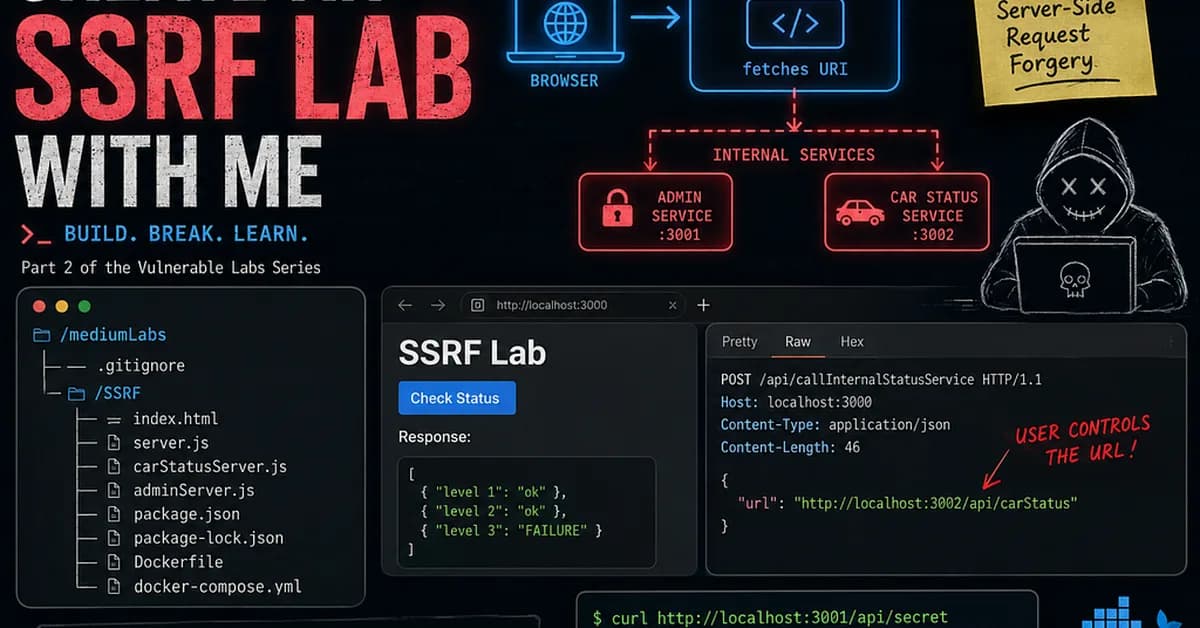
The author describes setting up a Docker environment with multiple services running on different ports, but only exposing port 3000 externally.
-
A vulnerable endpoint is created that accepts an arbitrary URL from the request body and makes a fetch() call to it without any validation or sanitization.
-
This allows an attacker to reach internal endpoints like http://localhost:3002/api/carStatus which are not accessible directly from outside Docker.
-
The main issue highlighted is lack of proper input validation/sanitization for the URL parameter.
-
Two potential mitigation strategies are discussed:
- Client-side and server-side sanitization/validation
- Using a different design pattern that doesn't accept full URLs, but only endpoint names
-
A challenge is posed to readers to implement their own filtering mechanism between extracting the URL from the request body and making the fetch call.
-
The author invites readers to expand on this lab or create their own vulnerable labs for practice.
The key takeaway is that accepting unvalidated URLs in server-side code can lead to SSRF vulnerabilities, which need
Read the full article at InfoSec Write-ups - Medium
Want to create content about this topic? Use Nemati AI tools to generate articles, social posts, and more.