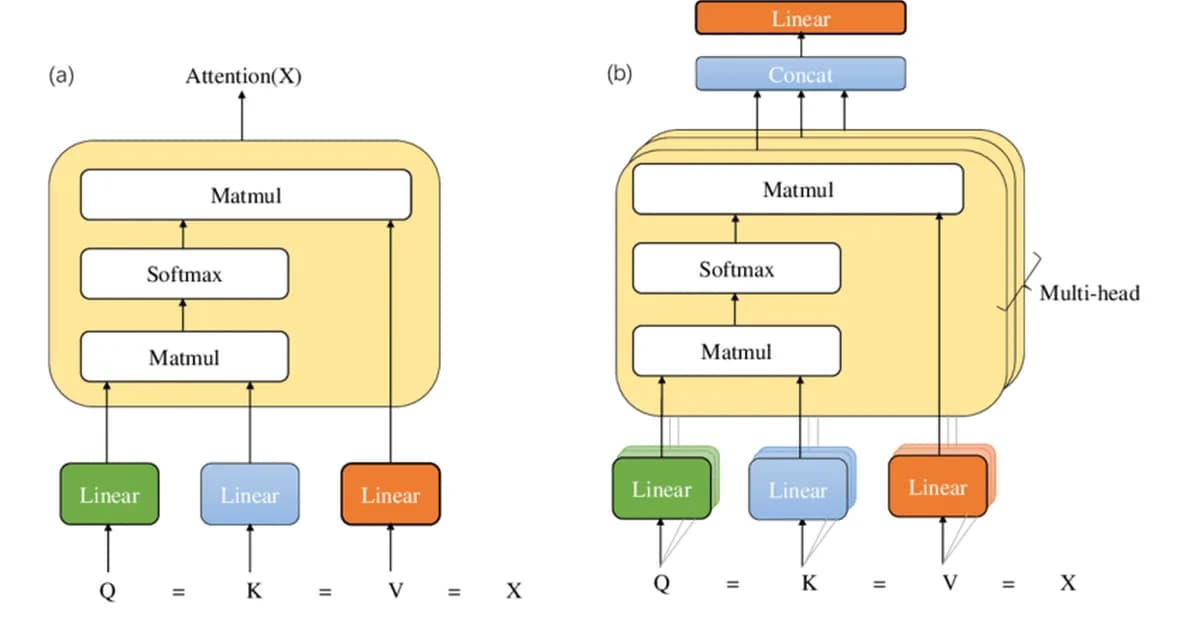
It looks like you're working on an exercise to understand single-head attention in the context of a simplified version of GPT. The provided code snippet outlines how to manually construct and compute the attention mechanism without using learned projections, which allows for clearer insight into its mechanics.
Let's break down the steps needed to complete this exercise:
- Setup Embedding Vectors: Define three cached positions with embedding size 4 where each position has distinct
K(key) andV(value) vectors. - Construct Query Vector: Create a query vector (
Q) that aligns well with one of the keys to see how attention weights are distributed. - Compute Attention Weights: Calculate dot products between the query and each key, then apply softmax normalization.
- Generate Output Vector: Combine values using the computed attention weights.
Here's an example implementation for Chapter9Exercise.cs:
csharp1using static MicroGPT.Helpers; 2 3namespace MicroGPT 4{ 5 public static class Chapter9Exercise 6 { 7 public static void Main() 8 { 9 int embeddingSize = 4; 10 11 // Define cached keys and values 12 List<Value[]> cachedKeys = new List<Value[]> 13 { 14 15[Read the full article at DEV Community](https://dev.to/garyljackson/chapter-9-single-head-attention-tokens-looking-at-each-other-328j) 16 17--- 18 19**Want to create content about this topic?** [Use Nemati AI tools](https://nemati.ai) to generate articles, social posts, and more.
2

Ali NematiWritten by Ali
![[AINews] The Unreasonable Effectiveness of Closing the Loop](/_next/image?url=https%3A%2F%2Fmedia.nemati.ai%2Fmedia%2Fblog%2Fimages%2Farticles%2F600e22851bc7453b.webp&w=3840&q=75)