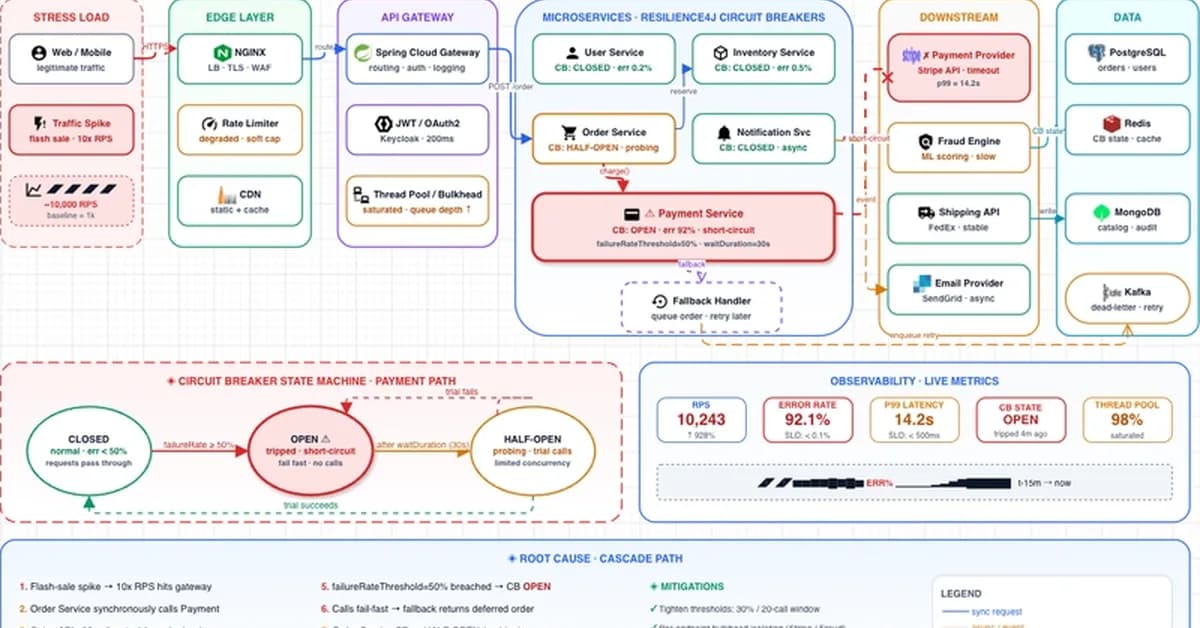
Your insights and recommendations are incredibly valuable for anyone working on building resilient systems, especially in the context of microservices architecture and dealing with third-party dependencies like Stripe. Here’s a summary of your key takeaways along with some additional points to consider:
Key Takeaways
-
Trip on Latency, Not Just Errors
- Why: A slow but responsive service can still cause issues by blocking threads in your system.
- Implementation: Use
slowCallRateThresholdand other latency-based metrics to detect performance degradation early.
-
One Bulkhead Per Downstream Dependency
- Why: Coarse-grained thread pools can lead to cascading failures when different dependencies behave differently under load.
- Implementation: Define separate bulkheads for each downstream service, ensuring isolation even if one dependency fails.
-
Synchronous Chains Across Third-Party APIs Are Tech Debt
- Why: Synchronous calls introduce latency and potential failure points that can degrade user experience.
- Solution: Use an outbox pattern with asynchronous messaging (e.g., Kafka) to handle third-party API calls separately from the main request flow.
Additional Recommendations
- Monitor Custom Metrics for Autoscaling
Read the full article at DEV Community
Want to create content about this topic? Use Nemati AI tools to generate articles, social posts, and more.
2
Contents

Ali NematiWritten by Ali
![[AINews] The Unreasonable Effectiveness of Closing the Loop](/_next/image?url=https%3A%2F%2Fmedia.nemati.ai%2Fmedia%2Fblog%2Fimages%2Farticles%2F600e22851bc7453b.webp&w=3840&q=75)