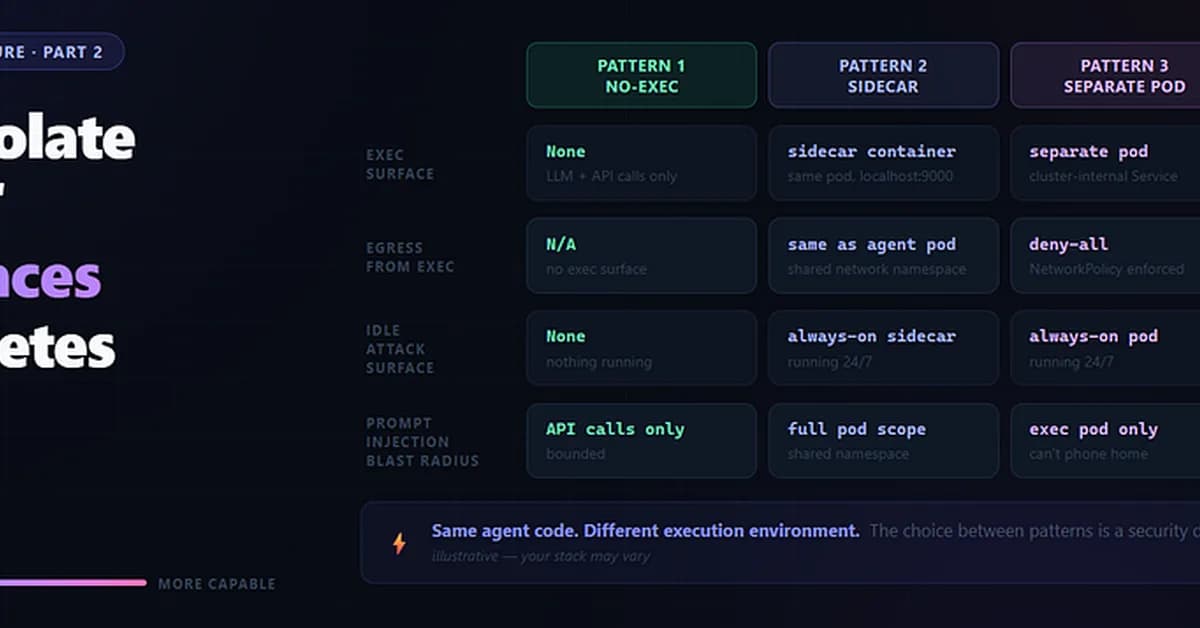
Based on your detailed exploration of different patterns to manage execution environments for agents in a Kubernetes cluster, here are some key takeaways and recommendations:
Key Takeaways
-
Default Security Posture:
- Start with the most restrictive security settings (
readOnlyRootFilesystem,allowPrivilegeEscalation=false, dropped capabilities) unless there's a clear need to deviate from this baseline.
- Start with the most restrictive security settings (
-
Execution Patterns:
-
No-Exec (Pattern 1): The default and safest option, where agents do not have the ability to execute arbitrary code.
-
Sidecar Exec (Pattern 2):
- Simpler operational overhead but less secure due to shared namespace with the agent pod.
- Suitable for internal tools or tightly controlled environments.
-
Separate Pod Exec (Pattern 3):
- Provides stronger isolation by moving the exec environment out of the main agent pod.
- Deny-all egress network policy limits exposure significantly.
- More operational overhead due to separate deployments and services but better security posture for untrusted inputs.
-
Ephemeral Jobs (Pattern 4):
- Combines the benefits of Pattern 3 with additional advantages
-
Read the full article at Towards AI - Medium
Want to create content about this topic? Use Nemati AI tools to generate articles, social posts, and more.
3
Contents

Ali NematiWritten by Ali
![[AINews] The Unreasonable Effectiveness of Closing the Loop](/_next/image?url=https%3A%2F%2Fmedia.nemati.ai%2Fmedia%2Fblog%2Fimages%2Farticles%2F600e22851bc7453b.webp&w=3840&q=75)