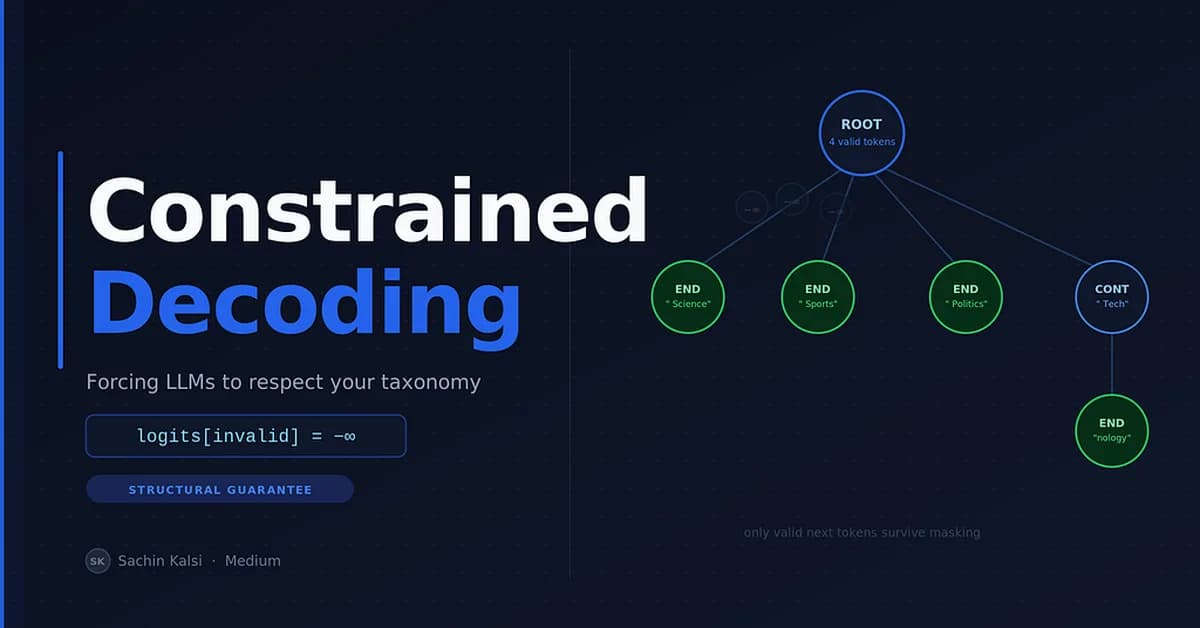
The correctness proof for trie-based constrained decoding hinges on maintaining two key invariants throughout the entire generation process:
1. Forward Invariant: Validity of Tokens at Each Step
At each decoding step (t), the processor ensures that the set of valid tokens (those not masked to (-\infty)) consists only of tokens that would continue a valid path through the trie. This invariant is maintained by:
- Trie Querying: The processor queries the trie for valid next tokens based on the current sequence of generated tokens.
- Masking Invalid Tokens: All tokens that do not form part of any valid continuation are masked to (-\infty), ensuring they cannot be sampled.
2. Backward Invariant: Completeness and Termination
The backward invariant ensures that if a complete label has been formed, the model can either terminate by emitting an EOS token or continue with another label via a separator token:
- EOS Token: If the current sequence of tokens forms a complete label (as determined by the trie), the processor adds the EOS token to the set of valid tokens.
- Separator Handling: When continuing to generate additional labels, already emitted labels are excluded from future selections at the
Read the full article at Towards AI - Medium
Want to create content about this topic? Use Nemati AI tools to generate articles, social posts, and more.
2
Contents

Ali NematiWritten by Ali
![[AINews] The Unreasonable Effectiveness of Closing the Loop](/_next/image?url=https%3A%2F%2Fmedia.nemati.ai%2Fmedia%2Fblog%2Fimages%2Farticles%2F600e22851bc7453b.webp&w=3840&q=75)