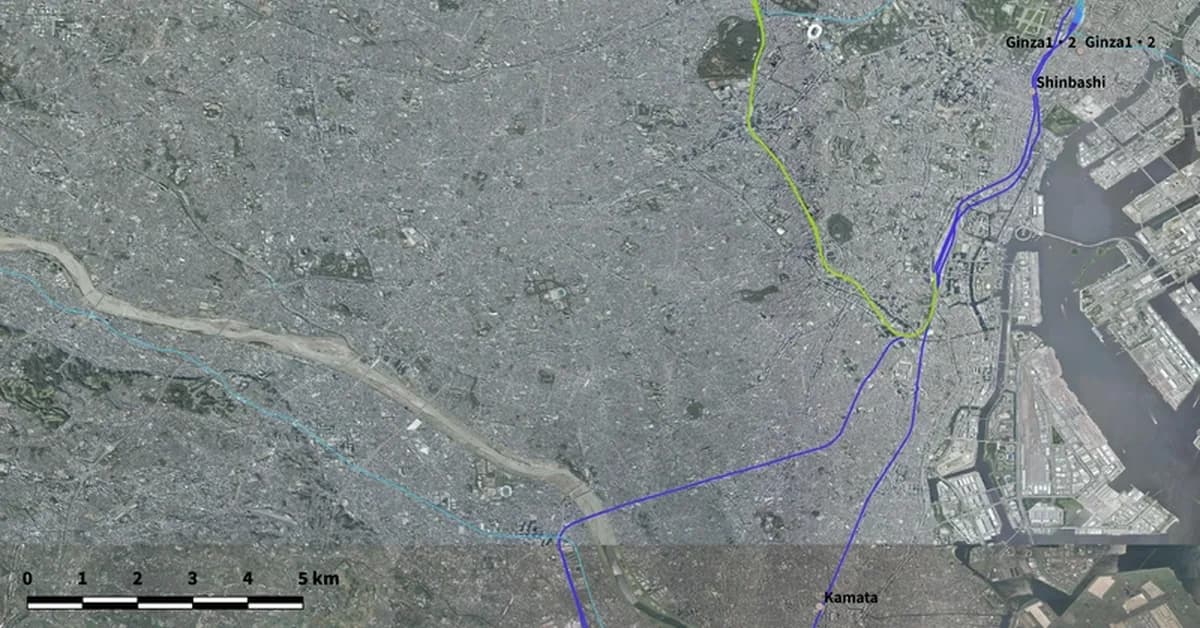
The analysis presented in the article provides a detailed exploration of how different stations within a transportation network can be characterized and compared using statistical manifolds. The key findings and insights from this study are as follows:
Key Insights
-
Behavioral Manifold Representation:
- Each station's behavior is represented by a distribution over 15 features, each modeled with an exponential family distribution (e.g., Gaussian, Poisson). This approach captures the variability in passenger flows, dwell times, and other relevant metrics.
-
KL Divergence Analysis:
- The KL divergence between stations reveals significant differences in their operational characteristics. For instance, Shinbashi shows high divergence from all other stations, indicating unique behaviors not observed elsewhere.
-
Geodesic Paths:
- Both e-geodesics (in natural parameter space) and m-geodesics (in expectation parameter space) are used to measure distances between distributions. The asymmetry in these paths highlights the curvature of the manifold.
-
Nonlinearity Assessment:
- High nonlinearity is observed for pairs like Kamata↔Shinbashi, indicating that moving from one station's behavior to another involves significant changes
Read the full article at DEV Community
Want to create content about this topic? Use Nemati AI tools to generate articles, social posts, and more.
5
Contents

Ali NematiWritten by Ali
![[AINews] The Unreasonable Effectiveness of Closing the Loop](/_next/image?url=https%3A%2F%2Fmedia.nemati.ai%2Fmedia%2Fblog%2Fimages%2Farticles%2F600e22851bc7453b.webp&w=3840&q=75)