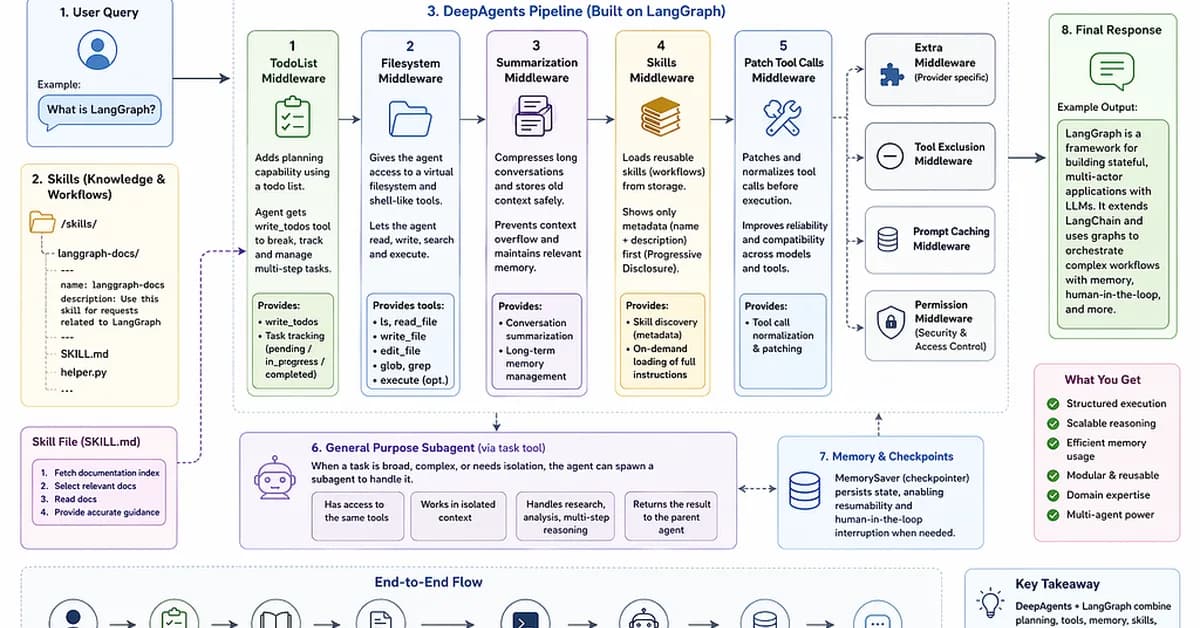
The article "Deconstructing Agent Skills: A LangGraph Deep Dive" delves into a significant shift in how artificial intelligence systems are being developed and utilized. The focus is on understanding Anthropic's introduction of "skills," which initially appears as a simple feature but turns out to be part of a broader design philosophy for building more effective AI systems.
Key Insights from the Article
-
Skills as Part of a Broader Design Philosophy:
- Skills alone are not revolutionary; they represent one aspect of a larger approach that emphasizes structuring problem-solving around models rather than making the models themselves smarter.
-
Externalized Planning and Structured Problem Solving:
- The system uses external planning mechanisms (like todo lists) to break down complex tasks into manageable steps, allowing for systematic progress.
-
Modular Knowledge Representation:
- Skills provide modular knowledge that can be selectively loaded based on relevance, reducing cognitive overload and improving efficiency.
-
Tool-Driven Execution:
- The system leverages a set of tools (like read_file, write_file) to interact with its environment, enabling it to execute tasks beyond just thinking or generating text.
-
Managed Memory:
Read the full article at Towards AI - Medium
Want to create content about this topic? Use Nemati AI tools to generate articles, social posts, and more.
2
Tags
Contents

Ali NematiWritten by Ali
![[AINews] The Unreasonable Effectiveness of Closing the Loop](/_next/image?url=https%3A%2F%2Fmedia.nemati.ai%2Fmedia%2Fblog%2Fimages%2Farticles%2F600e22851bc7453b.webp&w=3840&q=75)