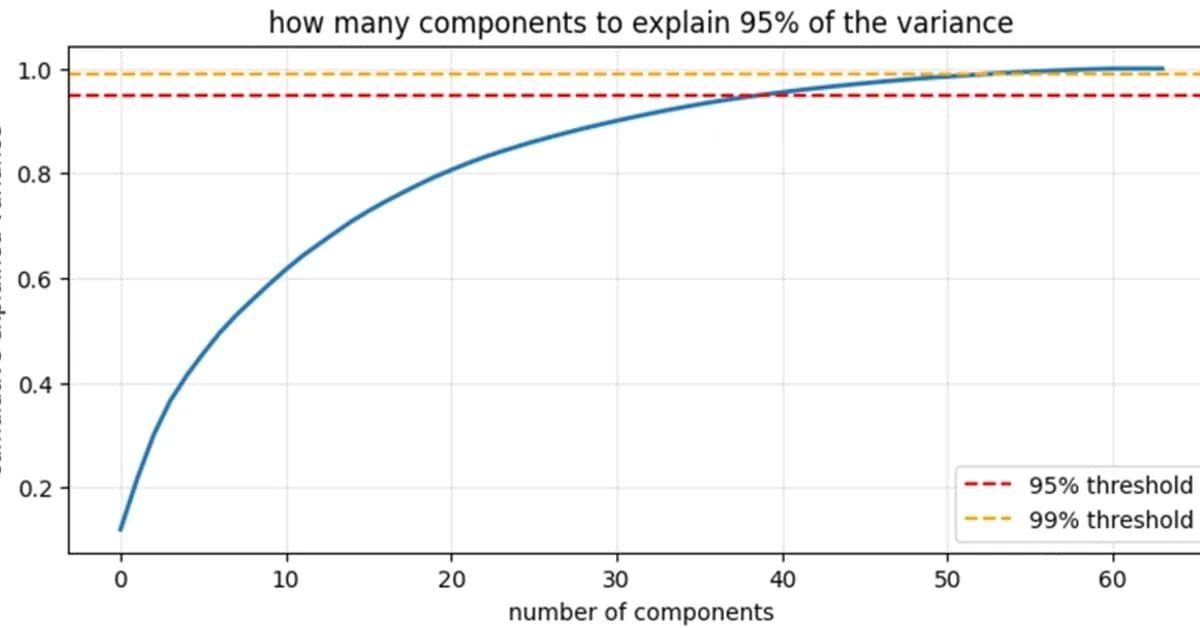
The provided code snippets demonstrate the use of two popular dimensionality reduction techniques: Principal Component Analysis (PCA) and t-Distributed Stochastic Neighbor Embedding (t-SNE). Let's break down each part:
1. PCA
Importing Libraries and Data Loading
python1from sklearn.decomposition import PCA 2import numpy as np
sklearn.decomposition.PCAis used for performing PCA.numpyis imported for numerical operations.
Scaling the Data
python1from sklearn.preprocessing import StandardScaler 2 3X_scaled = StandardScaler().fit_transform(X)
- The data
Xis scaled usingStandardScaler, which standardizes features by removing the mean and scaling to unit variance. This step is crucial before applying PCA because PCA is sensitive to the variances of the initial variables.
Running PCA
python1pca = PCA(n_components=2) 2X_pca = pca.fit_transform(X_scaled) 3 4print(pca.explained_variance_ratio_)
PCAwithn_components=2reduces the dimensionality of the data to 2 principal components.- The explained variance ratio is printed, which indicates how much information (variance)
Read the full article at DEV Community
Want to create content about this topic? Use Nemati AI tools to generate articles, social posts, and more.
6
Contents

Ali NematiWritten by Ali
![[AINews] The Unreasonable Effectiveness of Closing the Loop](/_next/image?url=https%3A%2F%2Fmedia.nemati.ai%2Fmedia%2Fblog%2Fimages%2Farticles%2F600e22851bc7453b.webp&w=3840&q=75)