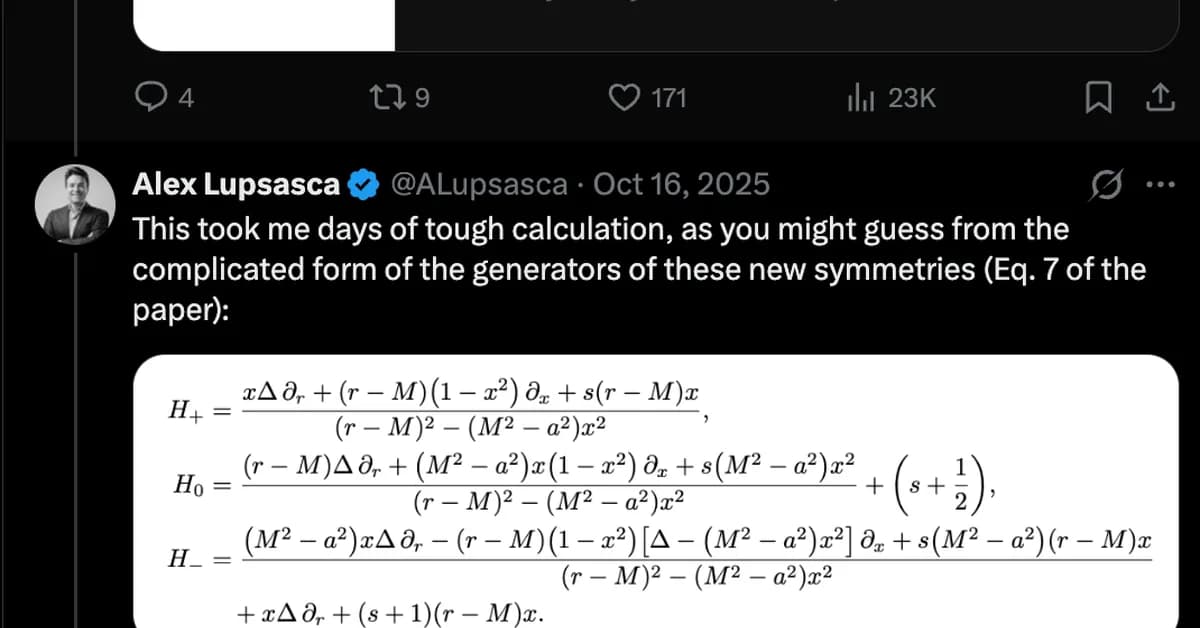
The story you've shared highlights a fascinating intersection between artificial intelligence and theoretical physics, showcasing how AI tools like ChatGPT are not only capable of performing complex calculations but also extending human knowledge in cutting-edge fields. Here’s a summary of key points:
Vibe Physics: A New Frontier
-
Alex's Background:
- Alex is an accomplished physicist who has won prestigious awards for his work.
- He was working on problems related to gluon and graviton amplitudes, which are fundamental in quantum field theory.
-
Initial Challenge:
- The problem of calculating gluon amplitudes had stumped experts for a year.
- Alex turned to AI tools like ChatGPT to explore new avenues.
-
Solving the Gluon Problem:
- By using prompts and iterative questioning, Alex was able to guide the AI through complex calculations.
- The AI provided solutions that were not only correct but also helped validate previous assumptions in theoretical physics.
-
Extending to Gravitons:
- After solving the gluon problem, Alex used similar techniques to tackle gravitons.
- This resulted in a new paper with novel results in quantum gravity, generated
Read the full article at Latent Space
Want to create content about this topic? Use Nemati AI tools to generate articles, social posts, and more.
Views162
Tags
On this page

Ali NematiBlogUI.author_articles