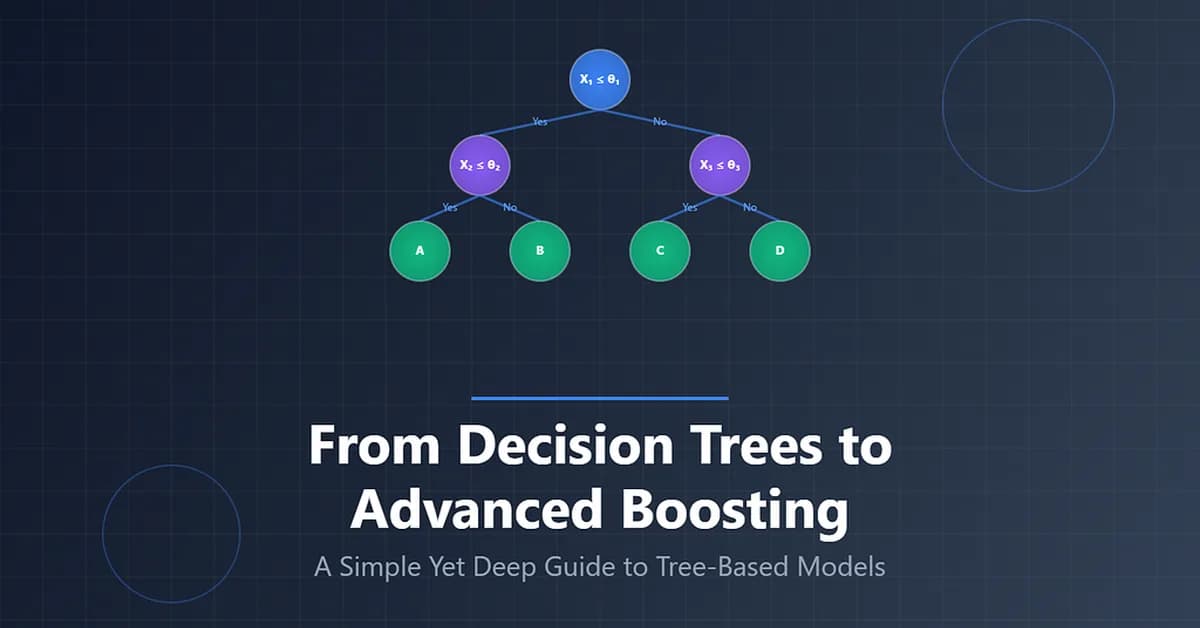
The article "From Decision Trees to Advanced Boosting: A Simple Yet Deep Guide to Tree-Based Models" provides a comprehensive overview of tree-based machine learning models, starting from basic concepts like decision trees and progressing through advanced ensemble methods such as boosting techniques. Here's a summary of the key points covered in the article:
1. Decision Trees
- Basic Concept: Decision trees are simple yet powerful predictive models that use a tree-like structure to make decisions based on input features.
- Advantages:
- Easy to interpret and visualize.
- Can handle both numerical and categorical data.
- Disadvantages:
- Prone to overfitting if not properly pruned.
2. Ensemble Methods
a. Bagging (Bootstrap Aggregating)
- Basic Concept: Bagging involves training multiple decision trees on different subsets of the dataset and averaging their predictions.
- Advantages:
- Reduces variance, making models more robust to noise in data.
- Disadvantages:
- Can be computationally expensive.
b. Random Forests
- Basic Concept: An extension of bagging where each tree is trained on a random
Read the full article at Towards AI - Medium
Want to create content about this topic? Use Nemati AI tools to generate articles, social posts, and more.
4
Tags
Contents

Ali NematiWritten by Ali
![[AINews] The Unreasonable Effectiveness of Closing the Loop](/_next/image?url=https%3A%2F%2Fmedia.nemati.ai%2Fmedia%2Fblog%2Fimages%2Farticles%2F600e22851bc7453b.webp&w=3840&q=75)