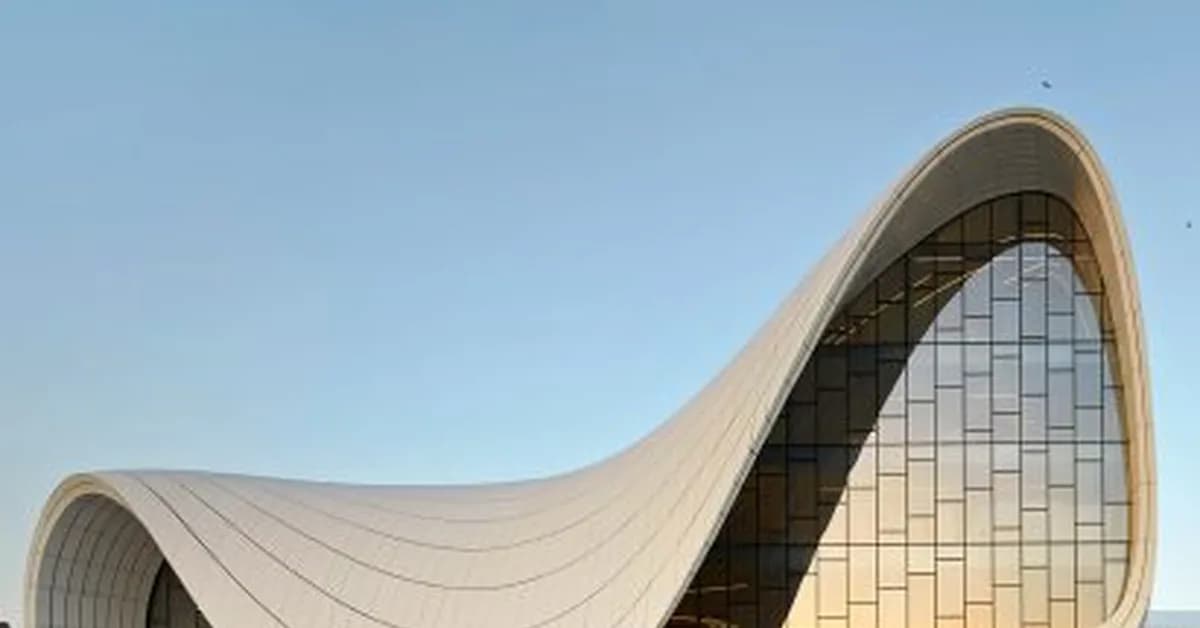
The Heydar Aliyev Center in Baku, Azerbaijan, is a prime example of the architectural style known as parametricism. Designed by Zaha Hadid Architects and completed in 2012, the building showcases seamless fluidity, akin to natural systems, which aligns with Patrik Schumacher's definition of parametricism.
The center presents an undulating form that blurs the boundaries between floor, wall, ceiling, and roof. Its facade rises to an eight-story peak on one side and ripples downwards towards a large plaza on the other. The building features vast, column-free spaces, achieved through a combination of concrete and steel space frames.
The exterior cladding consists of glass fiber reinforced concrete (GFRC) panels for lower sections and lighter glass fiber reinforced polyester (GFRP) panels for the roof. Each panel has either single, double, or triple curvature, with microchips to ensure precise positioning.
Inside, narrow strips of lighting emphasize the seamless nature of the interiors, while the main auditorium features a warm lining of curved timber panels against a clean white aesthetic. The center includes an impressive 1,000-seat theater and vast open spaces that reflect Hadid's interest in site planes
Read the full article at Dezeen
Want to create content about this topic? Use Nemati AI tools to generate articles, social posts, and more.