distillation improves the student model's performance compared to traditional supervised learning.
Here’s an overview of the key steps and concepts involved in this process:
-
Training the Teacher Ensemble:
- Multiple teacher models are trained independently until convergence.
- Each teacher is a large, complex model that captures different aspects of the data distribution due to its unique initialization and training path.
- The ensemble's predictions (logits) are averaged to create a strong collective prediction.
-
Generating Soft Targets:
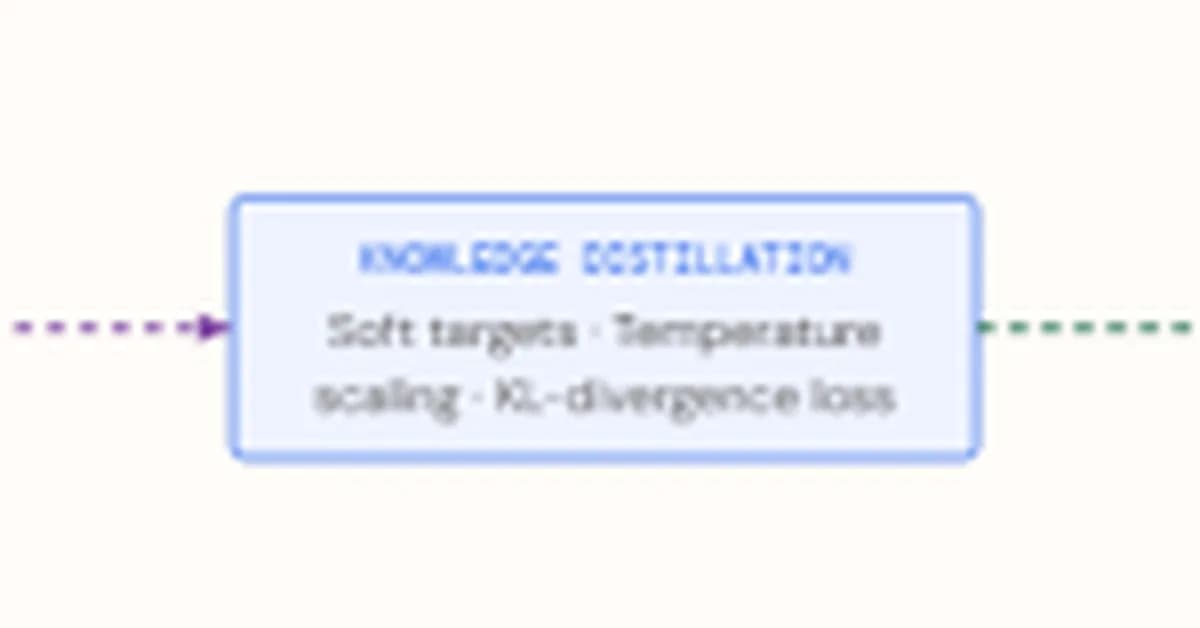
- Averaged logits from all teachers are used to generate soft targets through temperature scaling.
- These soft targets provide richer information compared to hard labels, capturing the confidence of each class prediction by the ensemble.
-
Training the Student via Distillation:
- The student model is trained using both hard labels and soft targets generated from the teacher ensemble.
- A combined loss function balances distillation (matching teacher's softened predictions) and standard supervised learning (aligning with ground truth).
- This hybrid approach allows the student to learn complex patterns that are difficult for it to discover on its own, leading to better performance.
-
Baseline Comparison:
- Training a baseline model using only hard labels provides
Read the full article at MarkTechPost
Want to create content about this topic? Use Nemati AI tools to generate articles, social posts, and more.
2

Ali NematiWritten by Ali
![[AINews] The Unreasonable Effectiveness of Closing the Loop](/_next/image?url=https%3A%2F%2Fmedia.nemati.ai%2Fmedia%2Fblog%2Fimages%2Farticles%2F600e22851bc7453b.webp&w=3840&q=75)