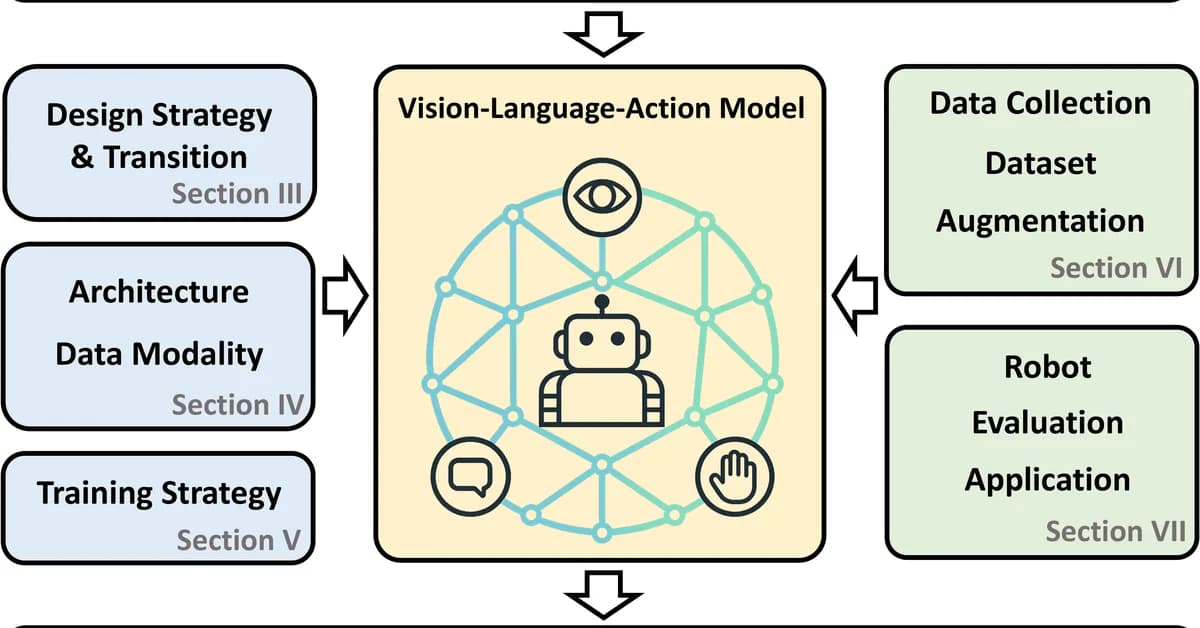
The article discusses the development of an embodied agent that integrates vision, language, and action capabilities through latent world modeling and model predictive control (MPC). The key points are:
-
Architecture Overview:
- The system consists of a perception module for visual input processing.
- A planning module uses latent dynamics to simulate future states.
- An MPC component selects actions based on predicted outcomes.
-
Implementation Details:
- Uses PyTorch and OpenCV without external rendering libraries.
- Trains a compact vision-based world model with image reconstruction and state prediction losses.
- Employs latent space for forward simulation in planning.
- Implements real-time replanning using MPC to minimize predicted distance to the goal.
-
Key Components:
- Perception Module: Processes visual inputs (images) into latent representations.
- Planning Module: Uses learned dynamics to simulate future states and outcomes.
- MPC Controller: Selects optimal actions by evaluating multiple candidate sequences in latent space.
-
Training Process:
- Trains the world model using a combination of image reconstruction loss and state prediction loss.
- Ensures lightweight architecture for efficient execution within constrained runtimes.
5
Read the full article at MarkTechPost
Want to create content about this topic? Use Nemati AI tools to generate articles, social posts, and more.
3
Tags

Ali NematiWritten by Ali
![[AINews] The Unreasonable Effectiveness of Closing the Loop](/_next/image?url=https%3A%2F%2Fmedia.nemati.ai%2Fmedia%2Fblog%2Fimages%2Farticles%2F600e22851bc7453b.webp&w=3840&q=75)