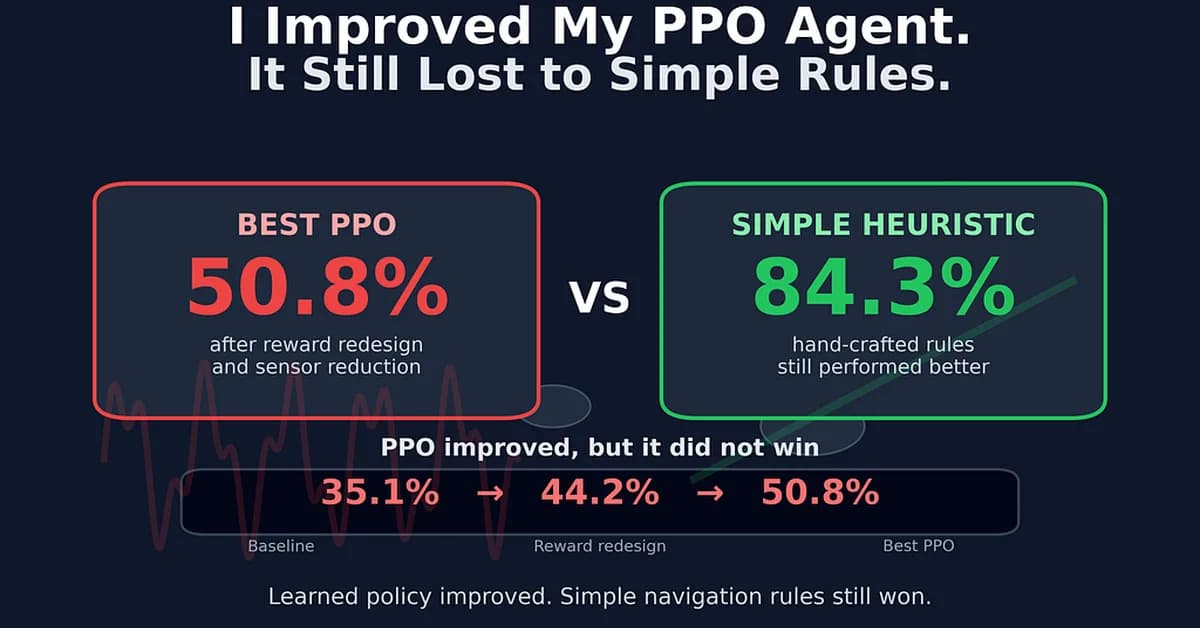
This project highlights several critical aspects of reinforcement learning (RL) and policy optimization that are often overlooked but crucial for understanding the true capabilities and limitations of RL agents. Here's a summary of key lessons learned:
-
Failure Mode Analysis: Instead of focusing solely on success rates, it’s essential to analyze failure modes in detail. This includes looking at collision rates, timeout rates, stuck rates, and path efficiency. Understanding why an agent fails can provide insights into what the agent has actually learned.
-
Observation Space Complexity: The project showed that increasing sensor resolution (e.g., lidar rays) does not necessarily improve performance under a fixed training budget and network architecture. This suggests that observation space complexity is a critical factor in RL, and more data does not always lead to better learning outcomes if the model cannot effectively process it.
-
Reward Ablation: Removing or altering reward terms can reveal whether an agent's behavior depends heavily on specific rewards. In this case, removing the progress reward led to catastrophic performance drops, indicating that the learned policy was heavily reliant on dense feedback rather than discovering a robust navigation strategy independently.
-
Baseline Comparison: Comparing against simple heuristic baselines is crucial for assessing the true effectiveness of an
Read the full article at Towards AI - Medium
Want to create content about this topic? Use Nemati AI tools to generate articles, social posts, and more.