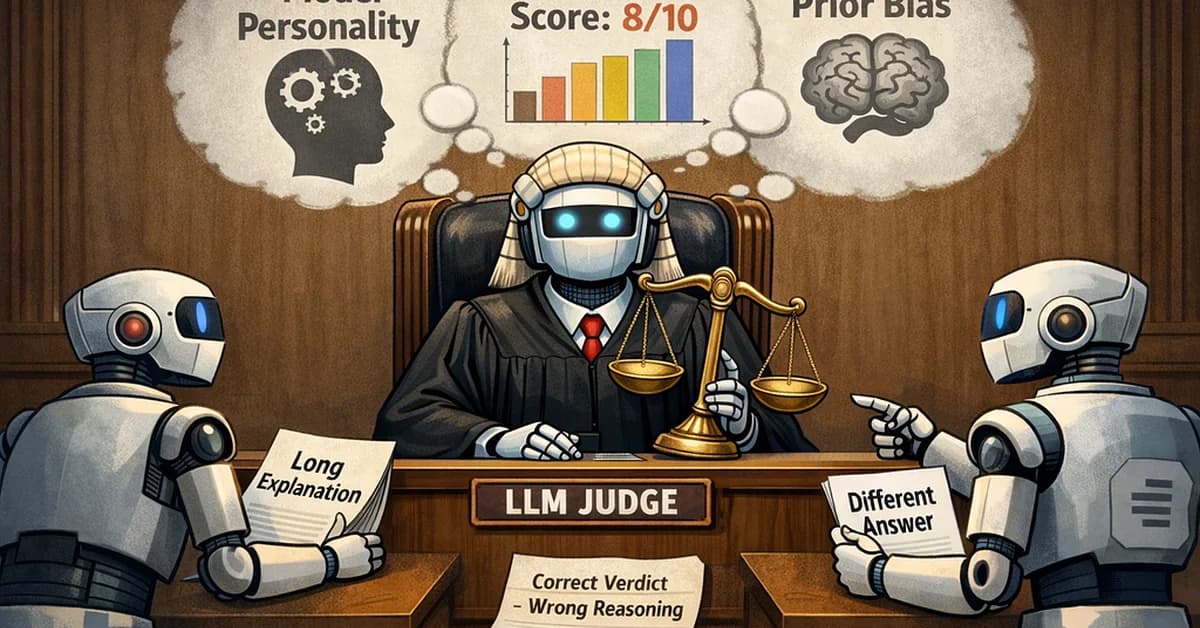
Large language models (LLMs) are increasingly used as evaluative tools, but their inherent biases and stochastic nature complicate objective assessment. Evaluating outputs through an LLM "judge" can introduce errors due to the judge's unique perspective, reliance on flawed reasoning from the original model, and undisclosed behavioral tendencies shaped by training data.
Developers must carefully characterize each LLM’s baseline behavior and evaluation criteria to mitigate these issues, ensuring more reliable automated assessments.
Read the full article at Towards AI - Medium
Want to create content about this topic? Use Nemati AI tools to generate articles, social posts, and more.
2
Tags

Ali NematiWritten by Ali
![[AINews] The Unreasonable Effectiveness of Closing the Loop](/_next/image?url=https%3A%2F%2Fmedia.nemati.ai%2Fmedia%2Fblog%2Fimages%2Farticles%2F600e22851bc7453b.webp&w=3840&q=75)