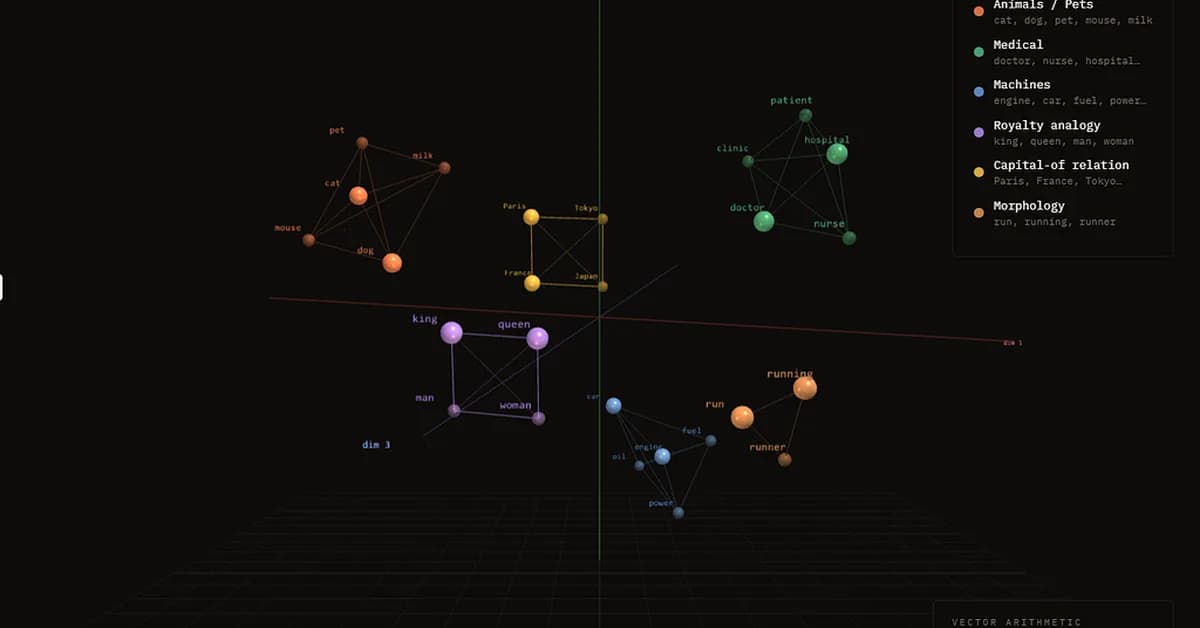
embeddings have indeed transcended their origins in natural language processing (NLP) and found applications across various domains. The core idea of embeddings—representing entities as points in a high-dimensional space where semantically similar items are closer together—has proven to be incredibly versatile.
Here's a deeper dive into how embeddings work beyond just words:
Sentences, Paragraphs, Documents
- Sentence Embeddings: Models like Sentence-BERT (SBERT) and Universal Sentence Encoder (USE) generate fixed-length vectors for sentences that capture their semantic meaning. These embeddings are used in tasks such as text classification, similarity search, and paraphrase detection.
- Paragraph/Document Embeddings: Techniques like Doc2Vec extend the concept of word embeddings to larger chunks of text by learning a vector representation for each document. This is useful for tasks like topic modeling, clustering, and information retrieval.
Images
- Image Embeddings: Convolutional Neural Networks (CNNs) are often used to generate image embeddings. These embeddings capture visual features that can be used for tasks such as image classification, object detection, and similarity search.
- Transfer Learning with CNNs: Models like ResNet or VGG pre-trained on large datasets like ImageNet
Read the full article at Towards AI - Medium
Want to create content about this topic? Use Nemati AI tools to generate articles, social posts, and more.
25
Contents

Ali NematiWritten by Ali
![[AINews] The Unreasonable Effectiveness of Closing the Loop](/_next/image?url=https%3A%2F%2Fmedia.nemati.ai%2Fmedia%2Fblog%2Fimages%2Farticles%2F600e22851bc7453b.webp&w=3840&q=75)