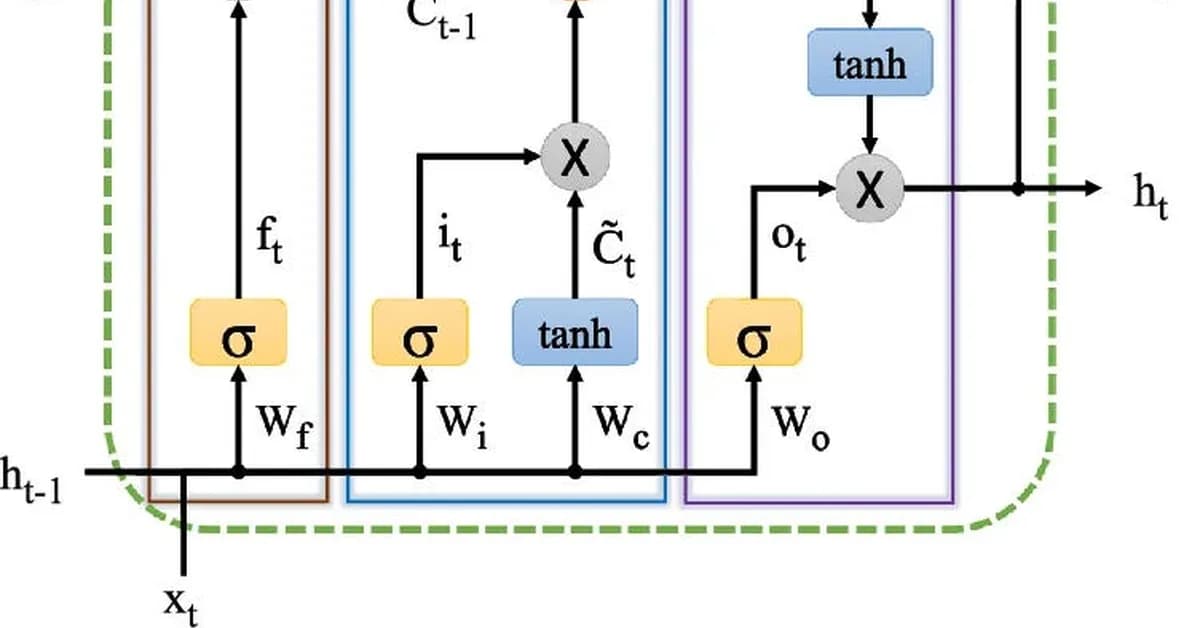
It all ties together beautifully, showing how the LSTM architecture addresses key challenges in sequence modeling and long-term dependency handling. Here's a concise summary of the main points:
-
Cell State (Cₜ):
- Acts as an internal memory that accumulates information over time.
- Remains unbounded but is designed to preserve long-term context.
-
Tanh Function:
- Normalizes and compresses the cell state, ensuring it stays within a manageable range (-1 to 1).
- Prevents exploding activations and ensures stability during training.
-
Output Gate (oₜ):
- Decides how much of the normalized cell state should be exposed as the hidden state.
- Scales from 0 to 1, controlling the amount but not the magnitude.
-
Hidden State (hₜ):
- Computed as ( h_t = o_t \odot \tanh(C_t) ).
- Combines normalization and filtering for stable gradient flow and output control.
-
Gradient Flow:
- LSTM separates gradient flow into two paths: a nonlinear exposed path through the hidden state (hₜ) and a stable memory
Read the full article at Towards AI - Medium
Want to create content about this topic? Use Nemati AI tools to generate articles, social posts, and more.
Views354

Ali NematiBlogUI.author_articles