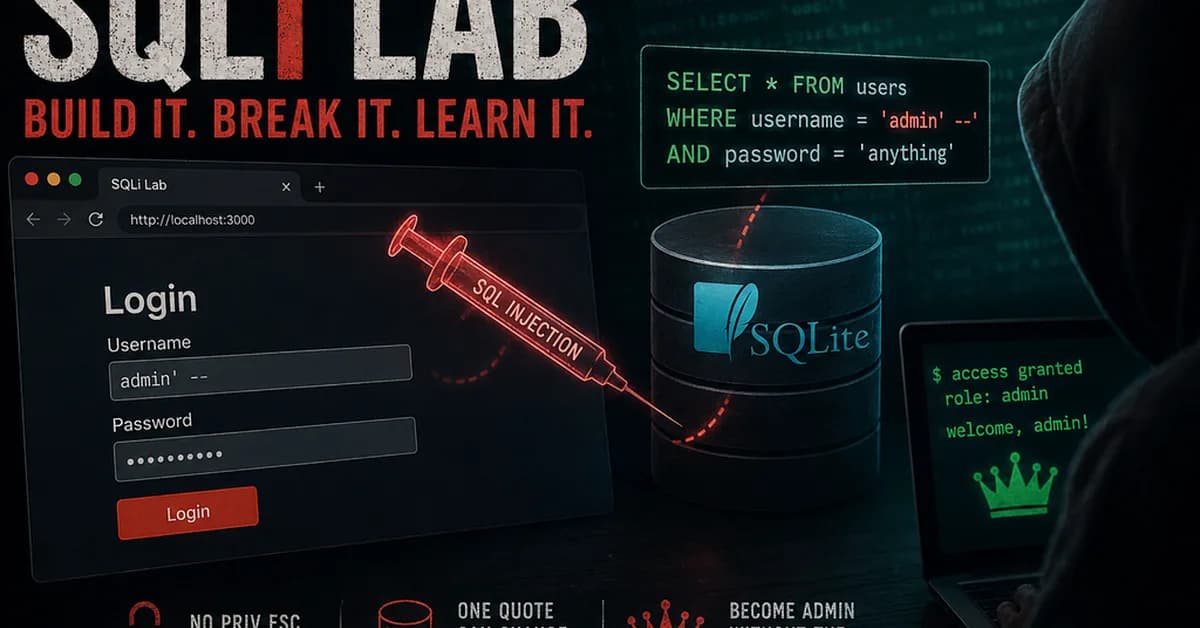
The article provides a detailed guide on how to create a SQL Injection (SQLi) lab for educational purposes. It walks through the process of setting up a vulnerable web application that can be exploited using SQL injection techniques. Here's a summary of key points:
-
Setting Up the Environment:
- The author uses Node.js with Express and SQLite as the database.
- Dependencies include
express,jsonwebtoken, andnodemon.
-
Creating the Vulnerable Code:
- A POST request to
/loginis created where user credentials are directly inserted into a SQL query without proper sanitization or parameterized queries. - Example of vulnerable code:
javascript
1const query = `SELECT * FROM users WHERE username = '${username}' AND password = '${password}'`;
- A POST request to
-
Exploiting the Vulnerability:
- By entering
' OR '1'='1as the password, an attacker can bypass authentication. - Another example payload is
admin' --, which comments out the rest of the query.
- By entering
-
Challenge:
- The challenge involves using UNION-based SQL injection to retrieve data from a different table.
- Example:
javascript
1undefined
Read the full article at InfoSec Write-ups - Medium
Want to create content about this topic? Use Nemati AI tools to generate articles, social posts, and more.
13

Ali NematiWritten by Ali