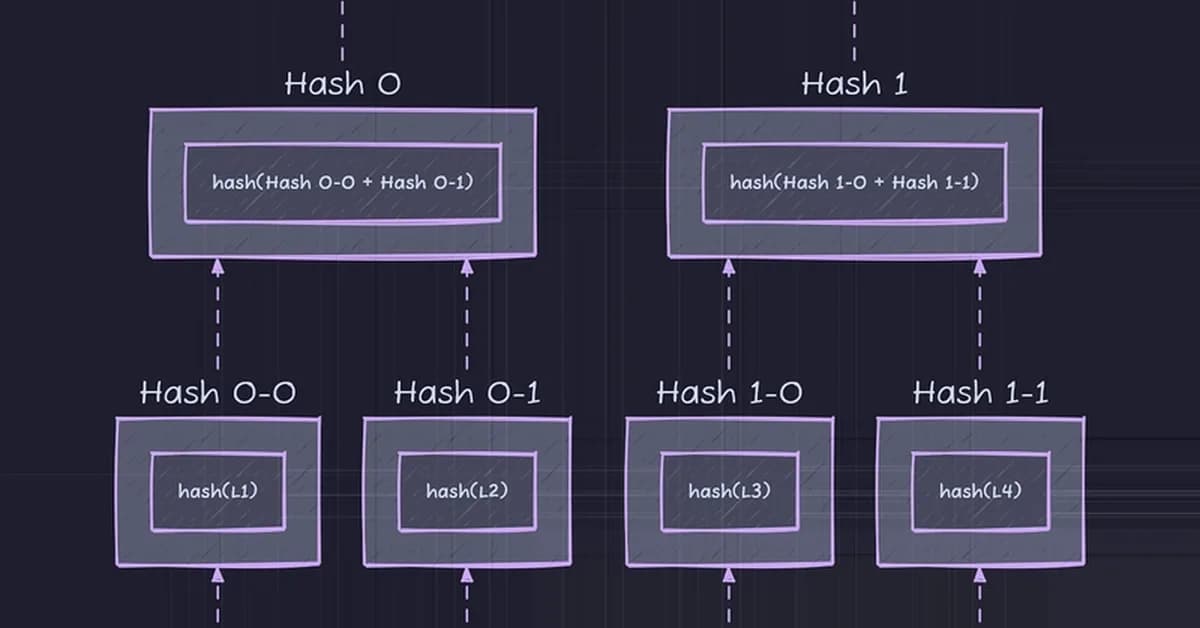
The article you've shared discusses how to construct a Merkle Tree and verify data blocks using a Merkle Proof. Here's a summary of the key points:
-
Merkle Tree Construction:
- A Merkle tree is built by recursively hashing pairs of nodes until there is only one node left, known as the Merkle Root.
- The process starts with individual data blocks (hashes) and combines them in pairs to form a new level of hashes.
-
Merkle Proof Verification:
- A Merkle proof includes all necessary sibling hashes needed to verify that a specific leaf node is part of the tree.
- For example, if you want to prove Data Block 1 is part of the tree, you need its hash and all sibling hashes up to the root.
-
Example Walkthrough:
- The article provides an example with data blocks and their corresponding Merkle Tree structure.
- It shows how each level of the tree is constructed by combining pairs of nodes' hashes.
- For Data Block 1, the proof includes its hash and all sibling hashes up to the root.
-
Merkle Proof in Practice:
- In a practical scenario
Read the full article at DEV Community
Want to create content about this topic? Use Nemati AI tools to generate articles, social posts, and more.
2

Ali NematiWritten by Ali
![[AINews] The Unreasonable Effectiveness of Closing the Loop](/_next/image?url=https%3A%2F%2Fmedia.nemati.ai%2Fmedia%2Fblog%2Fimages%2Farticles%2F600e22851bc7453b.webp&w=3840&q=75)