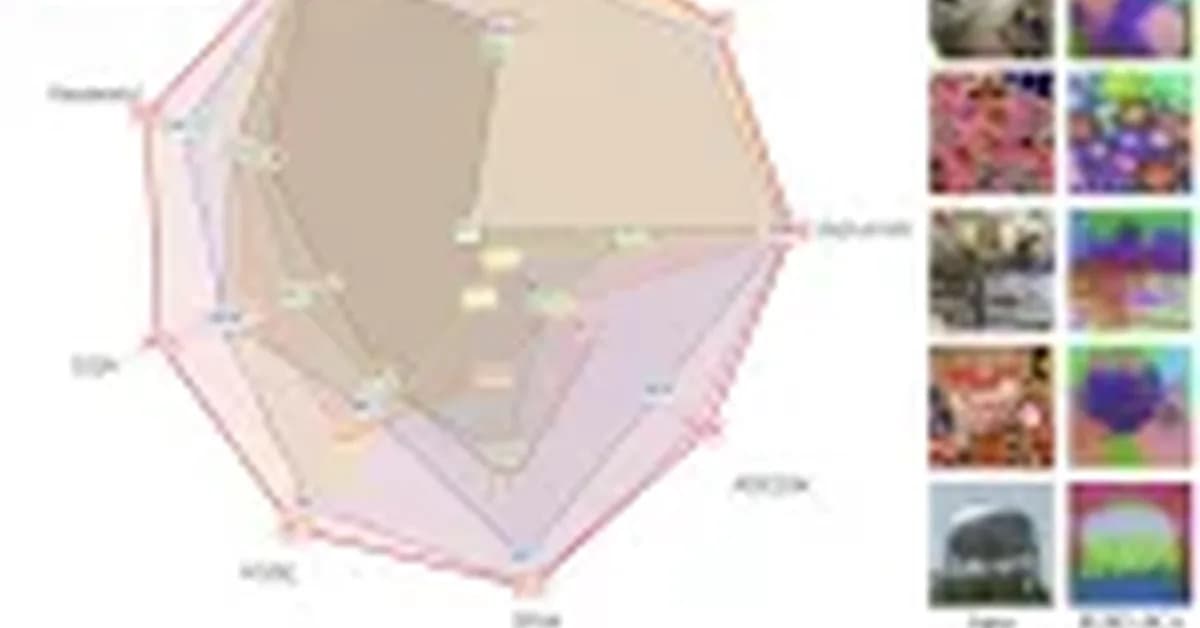
The research paper introduces EUPE (Unified Encoder for Perception and Embodiment), a compact vision encoder designed to excel across multiple domains including image understanding, dense prediction, and vision-language modeling. The key innovation is the three-stage distillation pipeline that first aggregates knowledge from specialized large models into a 1.9B parameter proxy model before distilling this unified knowledge into smaller, efficient student models (under 100M parameters). Here are the main takeaways:
Key Features of EUPE
Comprehensive Performance
- Image Understanding: Outperforms domain-specific models like PEcore-B and SigLIP2-B on benchmarks such as IN1k-KNN and IN1k-ZS.
- Dense Prediction: Matches or outperforms DINOv3-ViT-B on tasks like ADE20k mIoU and SPair-71k semantic correspondence.
- Vision-Language Modeling (VLM): Surpasses PEcore-B and SigLIP2-B in VQA benchmarks, including RealworldQA, GQA, TextVQA, SQA, and POPE.
Distillation Pipeline
- Stage 1: Aggregates knowledge from multiple large expert models into a single proxy
Read the full article at MarkTechPost
Want to create content about this topic? Use Nemati AI tools to generate articles, social posts, and more.
Views320
Tags
On this page

Ali NematiBlogUI.author_articles