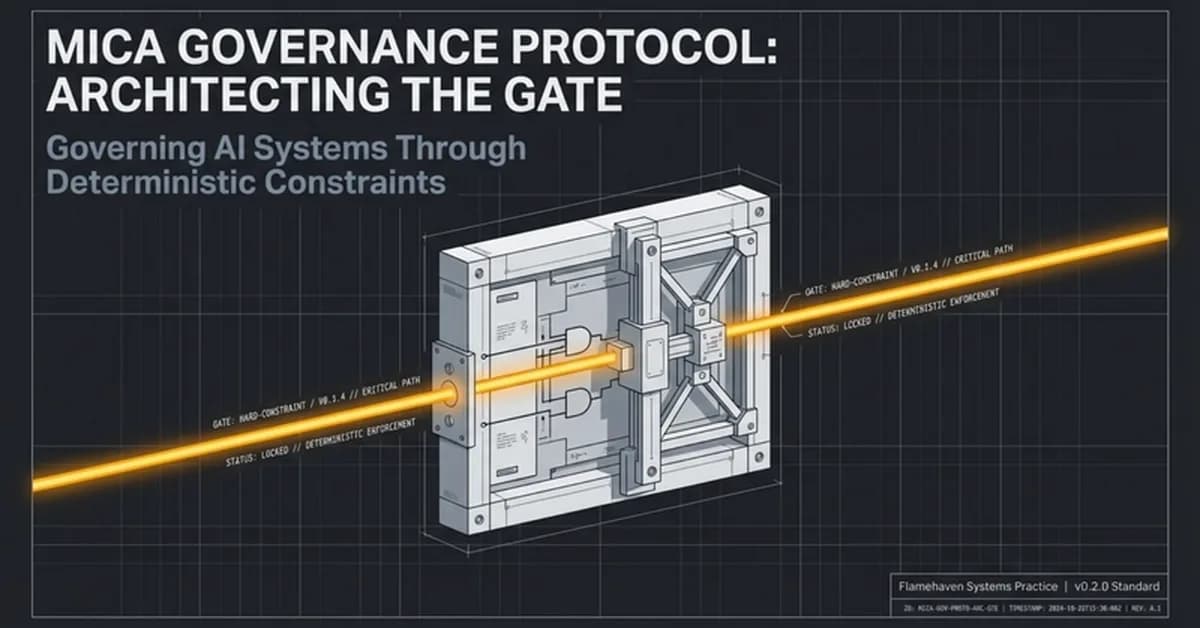
The post outlines how MICA (Maintenance Continuity Assurance) operates in practice, focusing on its application to maintaining an AI-driven website called Flamehaven.space. Here are key points and insights from the article:
-
Session Report as a Hard Gate: The session report is not merely informative; it's a mandatory checkpoint that ensures the model has loaded correctly and passed all necessary tests before proceeding with any changes.
-
Drift Reporting Mechanism: Drift reporting forces both the AI model and human operator to acknowledge what has changed in the project, ensuring they see the same altered surface before moving forward.
-
Design Invariants as Governing Constraints: These constraints are critical rules that guide the maintenance process, preventing the AI from making decisions that contradict the architectural intent of the system.
-
Human Authority Over Automation: While MICA provides a framework for maintaining consistency and governance, it does not automate every decision-making process. The operator retains authority over what becomes an invariant rule versus a temporary judgment call or playbook guideline.
-
Transition to More Complex Governance: Part 6 focuses on the simpler case of maintaining a single website. However, part 7 transitions into more complex scenarios where MICA must manage iterative learning and accumulation within
Read the full article at DEV Community
Want to create content about this topic? Use Nemati AI tools to generate articles, social posts, and more.

![[AINews] The Unreasonable Effectiveness of Closing the Loop](/_next/image?url=https%3A%2F%2Fmedia.nemati.ai%2Fmedia%2Fblog%2Fimages%2Farticles%2F600e22851bc7453b.webp&w=3840&q=75)