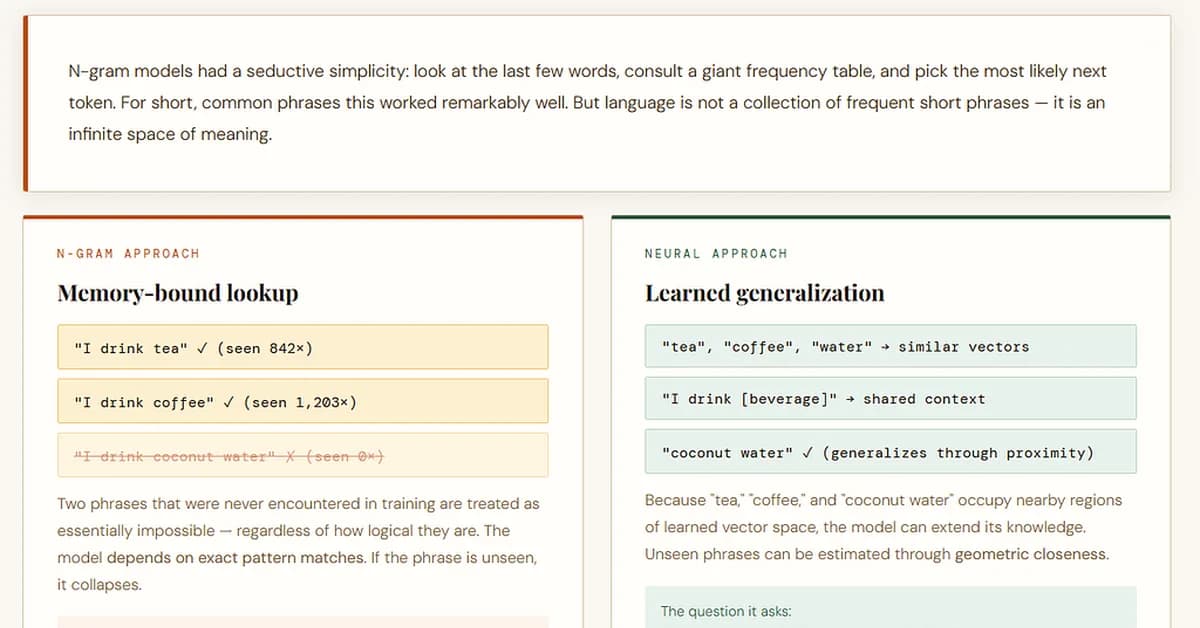
The article "Before RNNs: Early Neural Language Models and the Limits of Fixed Windows" discusses a pivotal phase in natural language processing (NLP) history when models transitioned from using frequency tables (n-grams) to learning representations through neural networks. This shift marked a significant advancement, but also highlighted limitations that would eventually lead to the development of Recurrent Neural Networks (RNNs).
Key Points:
-
From Counting Frequencies to Learning Representations:
- Early NLP models relied on n-grams, which are sequences of words used to predict the next word based on frequency counts.
- The introduction of neural language models allowed for a more nuanced approach where context was no longer just about counting nearby words but understanding their meaning through learned vector representations.
-
Limitations of Fixed Windows:
- Neural models with fixed windows (a set number of previous words) were an improvement over n-grams, as they could capture local context and learn meaningful word embeddings.
- However, these models still had a critical limitation: they couldn't handle long-range dependencies or maintain a continuous memory of the entire sentence.
-
The Need for Recurrence:
- The fixed window approach was
Read the full article at Towards AI - Medium
Want to create content about this topic? Use Nemati AI tools to generate articles, social posts, and more.
2
Contents

Ali NematiWritten by Ali
![[AINews] The Unreasonable Effectiveness of Closing the Loop](/_next/image?url=https%3A%2F%2Fmedia.nemati.ai%2Fmedia%2Fblog%2Fimages%2Farticles%2F600e22851bc7453b.webp&w=3840&q=75)