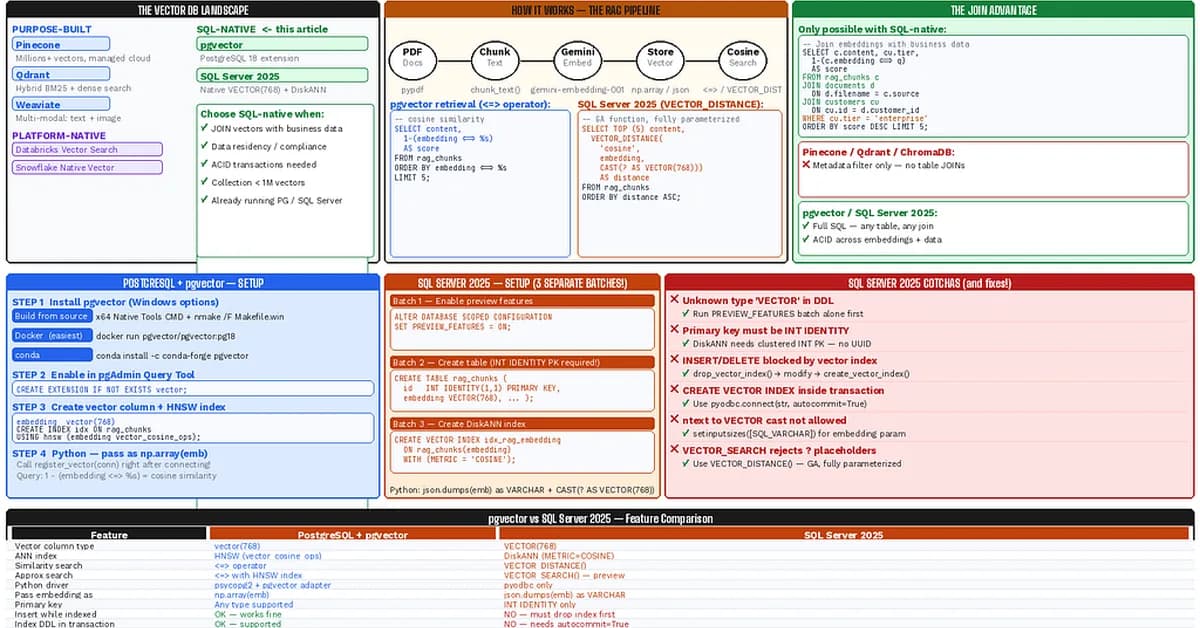
The provided content outlines a comprehensive guide on setting up and utilizing both PostgreSQL with the pgvector extension (referred to as pgvector) and SQL Server 2025 for storing, querying, and managing embeddings in a Retrieval-Augmented Generation (RAG) system. Below is a summary of key points and steps involved:
Part 1: PostgreSQL with pgVector
Setup
- Database Creation: Create a database in PostgreSQL.
- Table Creation: Define tables such as
rag_chunks,rag_staleness, etc., to store document chunks, metadata, and embeddings.
sql1CREATE TABLE rag_chunks ( 2 id SERIAL PRIMARY KEY, 3 source TEXT NOT NULL, 4 chunk_index INT NOT NULL, 5 content TEXT NOT NULL, 6 file_hash VARCHAR(64), 7 ingested_at TIMESTAMP DEFAULT CURRENT_TIMESTAMP, 8 embedding VECTOR(768) 9); 10 11-- Additional tables and indexes can be created similarly.
- Vector Index: Create a vector index on the
embeddingcolumn to enable efficient similarity searches.
sql1CREATE INDEX idx_rag_embedding ON rag_chunks USING ivfflat (embedding);
Python Integration
- Dependencies: Install necessary Python packages (`
Read the full article at Towards AI - Medium
Want to create content about this topic? Use Nemati AI tools to generate articles, social posts, and more.
5
Contents

Ali NematiWritten by Ali
![[AINews] The Unreasonable Effectiveness of Closing the Loop](/_next/image?url=https%3A%2F%2Fmedia.nemati.ai%2Fmedia%2Fblog%2Fimages%2Farticles%2F600e22851bc7453b.webp&w=3840&q=75)