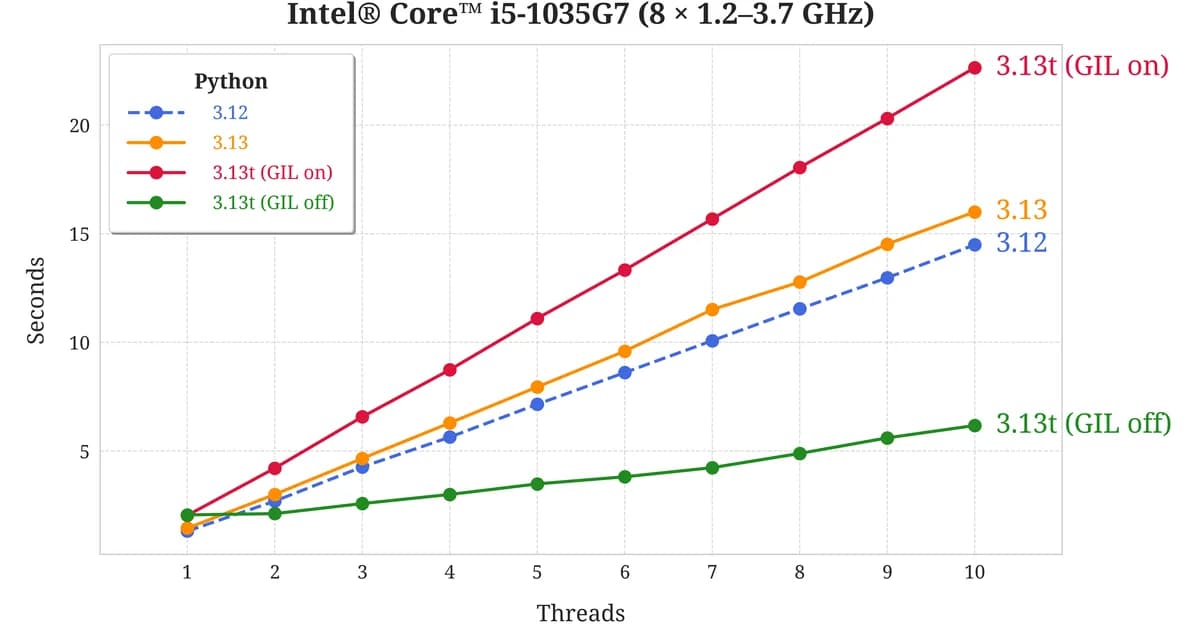
Python's journey towards becoming a more efficient language for multi-core processors has taken a significant step forward with Python 3.14, which introduced free-threading as an officially supported feature. This development marks a substantial change from the previous version, Python 3.13, where free-threading was still experimental and not recommended for production use due to potential issues and incomplete library support.
Key Developments in Python 3.14
Free-Threading (PEP 703)
Python 3.14 officially supports a "free-threaded" build mode that removes the Global Interpreter Lock (GIL), allowing threads to execute concurrently on multiple CPU cores without contention. This is particularly beneficial for applications with heavy CPU-bound workloads, such as data processing pipelines and numerical computations.
Compatibility and Testing
While Python 3.14 officially supports free-threading, it's important to note that many third-party libraries have yet to fully support this mode due to the complexities involved in ensuring thread safety and compatibility with C extensions. As a result, developers are advised to test their applications thoroughly before switching from the standard GIL-enabled build.
New Features
Python 3.14 also introduced several other features:
Read the full article at DEV Community
Want to create content about this topic? Use Nemati AI tools to generate articles, social posts, and more.

![[AINews] The Unreasonable Effectiveness of Closing the Loop](/_next/image?url=https%3A%2F%2Fmedia.nemati.ai%2Fmedia%2Fblog%2Fimages%2Farticles%2F600e22851bc7453b.webp&w=3840&q=75)