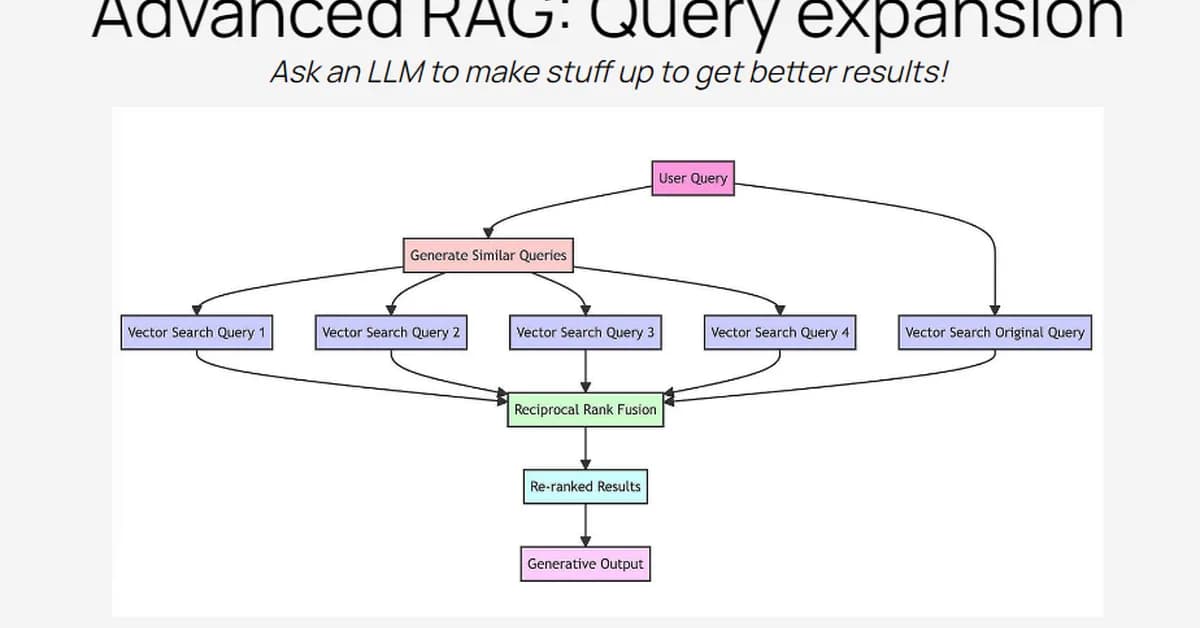
Summary of Query Optimization Strategies in RAG Systems
This article explores three query optimization strategies for Retrieval-Augmented Generation (RAG) systems and benchmarks them against a naive baseline. The goal is to improve the quality of retrieved documents by addressing different aspects of query formulation and retrieval.
1. Multi-Query
Description: This strategy involves generating multiple rephrased versions of the original query and retrieving documents based on these variations.
- Use Case: Effective when dealing with large knowledge bases where vocabulary is varied, as it helps in capturing different phrasings that might be used to express the same intent.
- Limitation: On small knowledge bases, redundancy can lead to no significant improvement since the base vector search already achieves near-perfect recall.
2. HyDE (Hypothetical Document Embedding)
Description: This strategy generates a hypothetical answer based on the query and uses its embedding for retrieval instead of the original query.
- Use Case: Best suited when there is a significant semantic gap between the question and the expected answer, especially in technical or specialized domains where precise phrasing matters.
- Improvement: Demonstrates the strongest improvement in ranking quality (context_precision +0.14
Read the full article at DEV Community
Want to create content about this topic? Use Nemati AI tools to generate articles, social posts, and more.
4
Tags
Contents

Ali NematiWritten by Ali
![[AINews] The Unreasonable Effectiveness of Closing the Loop](/_next/image?url=https%3A%2F%2Fmedia.nemati.ai%2Fmedia%2Fblog%2Fimages%2Farticles%2F600e22851bc7453b.webp&w=3840&q=75)