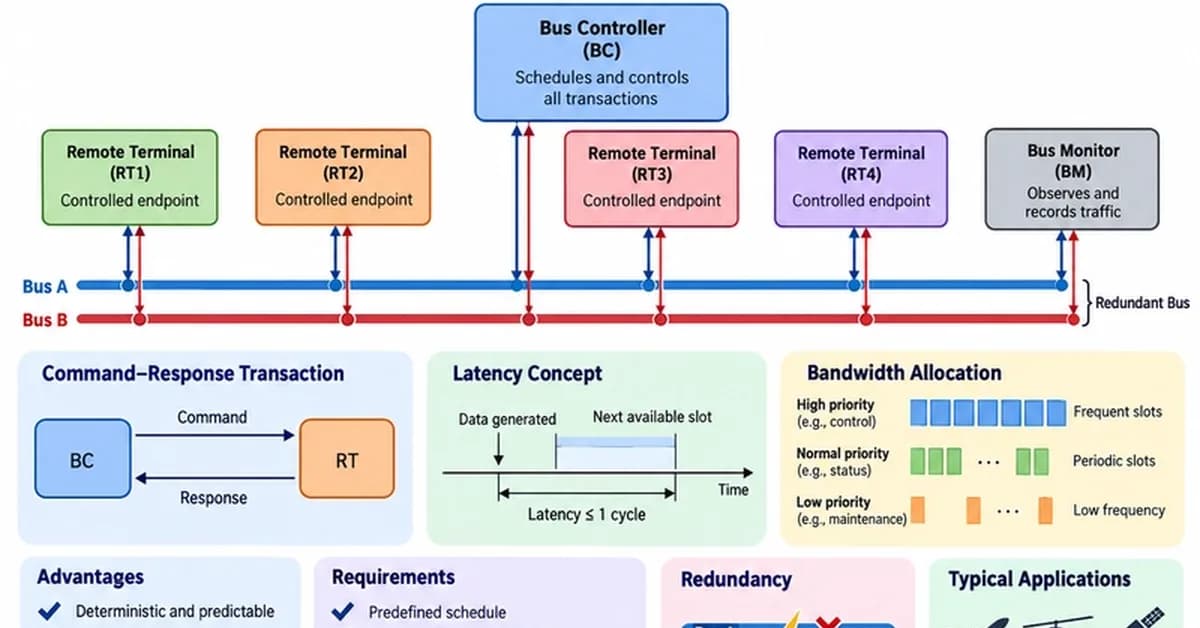
A communication architecture called MIL-STD-1553 utilizes Time Division Multiple Access (TDMA) to ensure predictable and controlled data transmission, particularly valuable for safety-critical aerospace systems. This approach assigns specific time slots for communication, preventing collisions and allowing for precise timing analysis, which contrasts with contention-based networks. The system relies on a Bus Controller (BC) to manage communication, Remote Terminals (RTs) to act as endpoints, and a Bus Monitor (BM) to observe traffic, creating a structured and analyzable communication environment.
Read the full article at DEV Community
Want to create content about this topic? Use Nemati AI tools to generate articles, social posts, and more.
Views0

Ali NematiBlogUI.author_articles