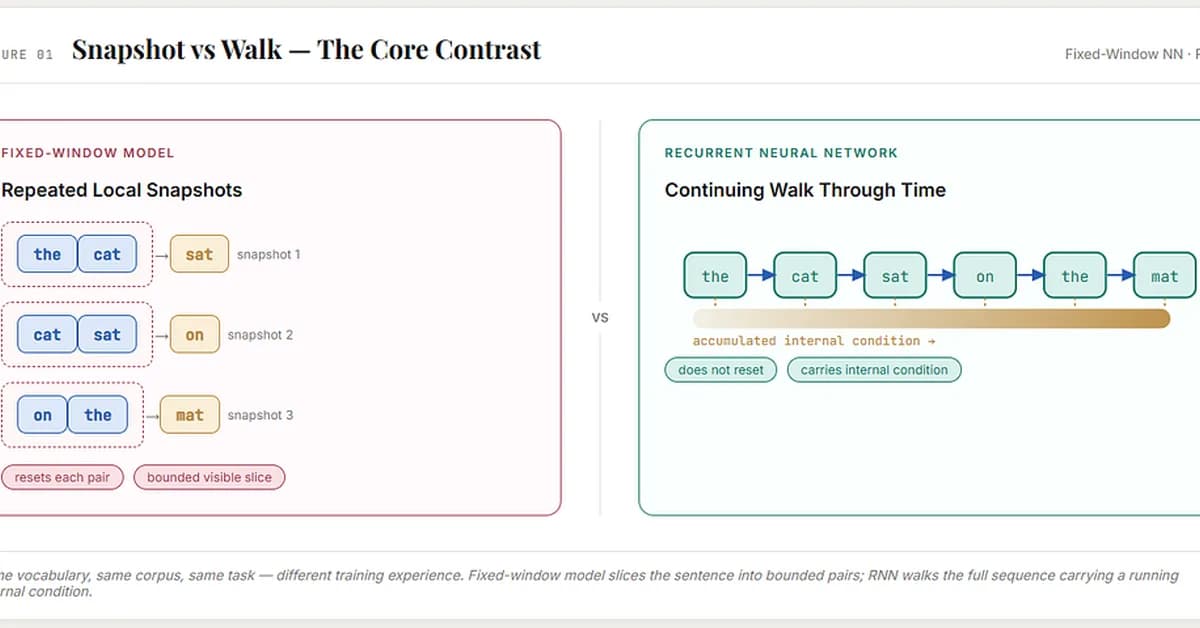
The explanation provided outlines the fundamental differences between a fixed-window model and an RNN (Recurrent Neural Network) in processing sequences of text, particularly focusing on how context is handled. Here are key points distilled from the detailed discussion:
-
Training Paradigm Shift:
- In a fixed-window model, training involves predicting the next word based solely on a static window of previous words.
- An RNN trains by moving through each word in a sentence sequentially and updating its internal state (condition) with each new input.
-
Contextual Understanding:
- Fixed-window models treat each prediction independently, ignoring how earlier parts of the sequence might influence later predictions.
- RNNs maintain an evolving context that changes as they read more words, allowing them to make better-informed predictions based on accumulated information from previous steps.
-
Generalization and Pattern Recognition:
- Through repeated training examples, RNNs can learn patterns such as the tendency for certain types of words (e.g., nouns) to follow others (e.g., articles like "the"), and further actions or descriptors to follow those nouns.
- This learning process helps the model generalize beyond specific instances in its training data.
-
**
Read the full article at Towards AI - Medium
Want to create content about this topic? Use Nemati AI tools to generate articles, social posts, and more.
Views208

Ali NematiBlogUI.author_articles