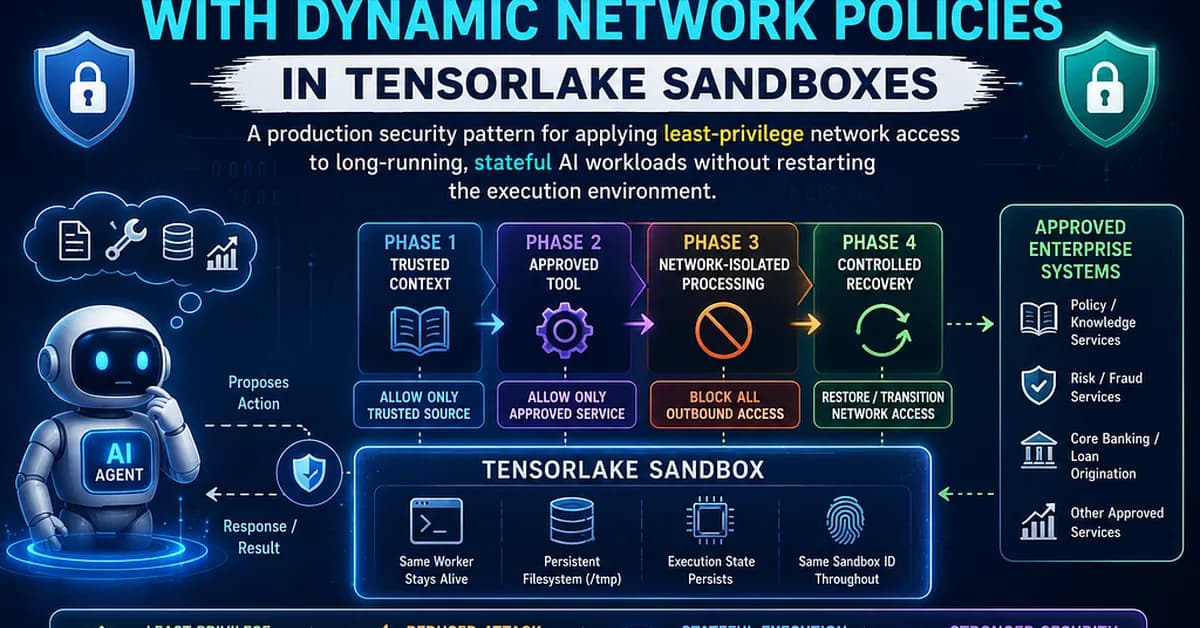
The experiments described illustrate an important architectural principle for managing security in complex workflows involving multiple phases of execution. The key takeaway is that the orchestrator should control the privilege lifecycle, while the workload focuses on executing tasks within the boundaries set by the orchestrator.
Here's a summary and analysis of the main points:
Key Concepts
-
Phase-Based Access Control:
- Each phase in the workflow has its own network policy.
- The orchestrator determines which phase is active and applies the corresponding network policy to the sandbox.
-
Trusted Context and Approved Tool Access:
- In Phase 1, the workload acquires a trusted context (e.g., accessing
buildaisystem.com). - In Phase 2, the network policy changes to allow access only to an approved tool or platform (
www.tensorlake.ai).
- In Phase 1, the workload acquires a trusted context (e.g., accessing
-
Network Isolation:
- By Phase 3, all necessary resources are available locally in the sandbox.
- The orchestrator restricts new outbound connections while allowing existing ones to continue.
-
Controlled Recovery:
- After isolated execution completes, the network policy is relaxed or removed to allow further actions if needed.
Detailed Analysis
Read the full article at Towards AI - Medium
Want to create content about this topic? Use Nemati AI tools to generate articles, social posts, and more.
Views6
On this page

Ali NematiBlogUI.author_articles