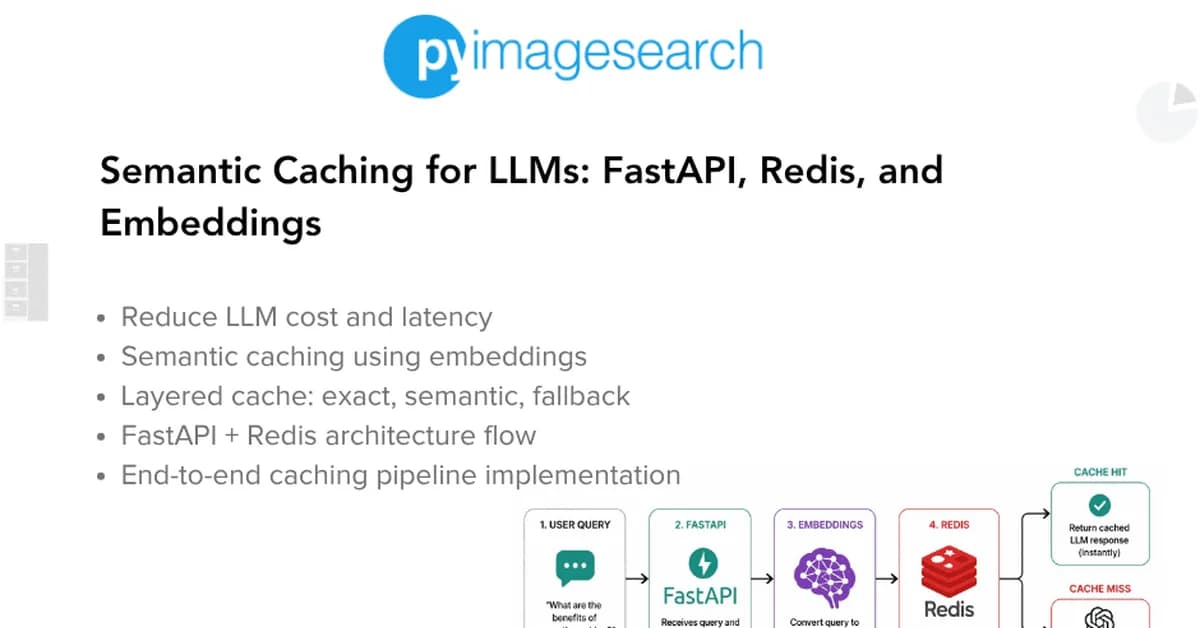
The architecture and request flow described in the lesson outline a multi-layer caching strategy for an LLM-backed service, aiming to minimize latency and unnecessary model calls. Here's a detailed breakdown of how this system operates:
High-Level System Components
- API Layer (FastAPI): Acts as the entry point for user requests, orchestrating the caching pipeline.
- Exact-Match Cache: Uses Redis to perform fast hash-based lookups for identical queries.
- Embedding Model (Ollama): Converts text queries into semantic vectors when needed.
- Semantic Cache: Also uses Redis but stores embeddings and responses, performing similarity matching.
- LLM (Ollama): Serves as the final fallback to generate a response if no suitable cache entry exists.
End-to-End Request Flow
Step 1: Request enters the API
- The FastAPI-based API receives a text query along with optional flags like
bypass_cache. - Input validation ensures that only meaningful queries proceed, preventing invalid entries from polluting the cache.
Step 2: Exact-Match Cache Lookup
- The incoming query is normalized and hashed.
- Redis checks if an identical query has been answered before
Read the full article at Blog - PyImageSearch
Want to create content about this topic? Use Nemati AI tools to generate articles, social posts, and more.
2
Contents

Ali NematiWritten by Ali
![[AINews] The Unreasonable Effectiveness of Closing the Loop](/_next/image?url=https%3A%2F%2Fmedia.nemati.ai%2Fmedia%2Fblog%2Fimages%2Farticles%2F600e22851bc7453b.webp&w=3840&q=75)