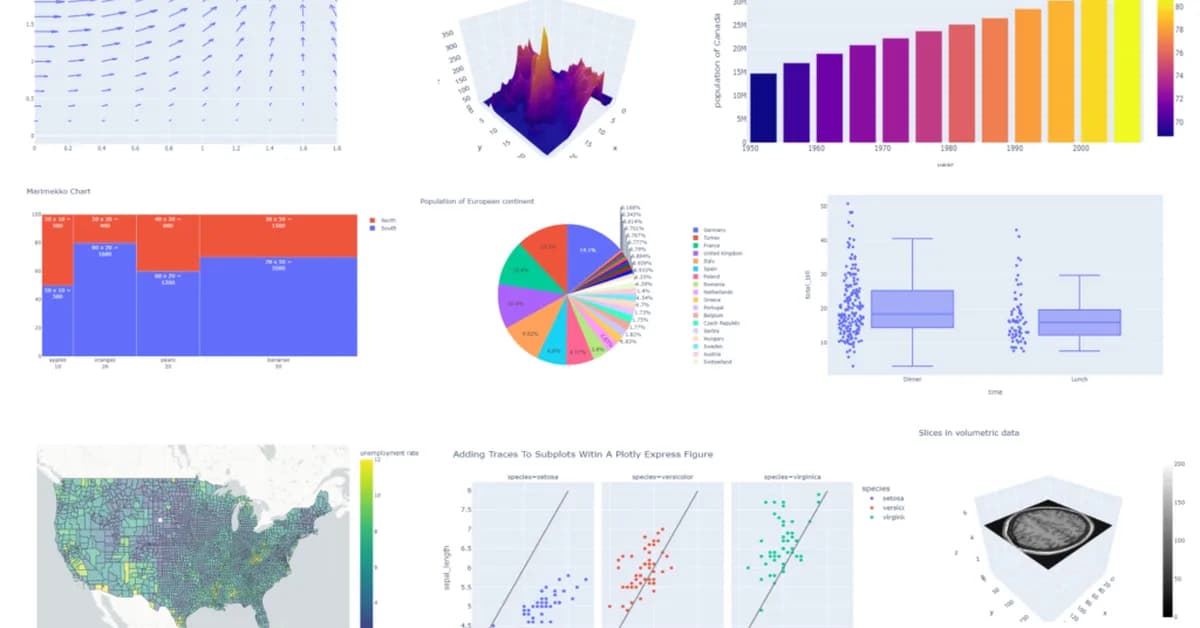
Plotly is a powerful tool for creating interactive and visually appealing data visualizations. The examples you've provided showcase different types of charts and maps that can be created using Plotly in Python, including scatter plots, bar charts, line charts, bubble charts, pie charts, histograms, box plots, violin plots, heatmaps, contour plots, 3D surface plots, streamlines, density plots, parallel coordinates plots, dendrograms, treemaps, sunburst charts, and choropleth maps. Here's a brief explanation of each type:
- Scatter Plot: Used to display the relationship between two variables.
- Bar Chart: Useful for comparing quantities across different categories.
- Line Chart: Ideal for showing trends over time or ordered categories.
- Bubble Chart: An extension of scatter plots, where the size of bubbles represents an additional variable.
- Pie Chart: Shows proportions of a whole using slices representing different categories.
- Histogram: Displays distribution of data by dividing it into intervals (bins).
- Box Plot: Summarizes statistical information about a dataset with quartiles and outliers.
- Violin Plot: Similar to box plots but also shows the kernel density
Read the full article at DEV Community
Want to create content about this topic? Use Nemati AI tools to generate articles, social posts, and more.
2

Ali NematiWritten by Ali
![[AINews] The Unreasonable Effectiveness of Closing the Loop](/_next/image?url=https%3A%2F%2Fmedia.nemati.ai%2Fmedia%2Fblog%2Fimages%2Farticles%2F600e22851bc7453b.webp&w=3840&q=75)