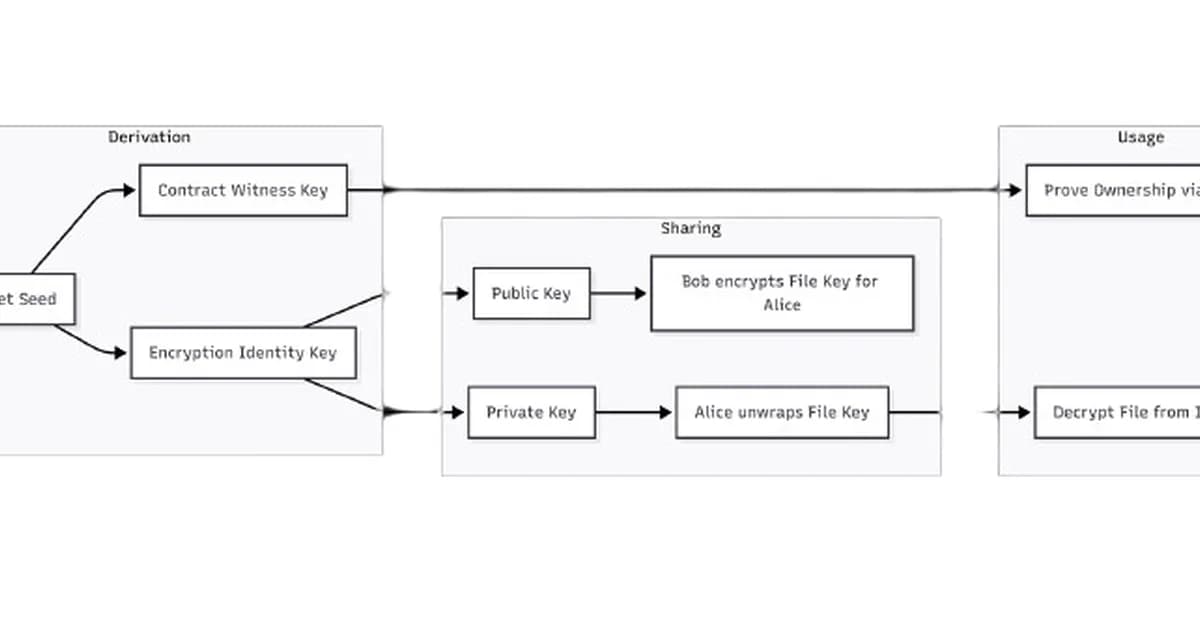
It looks like you're working on a secure document management system using Midnight, which is likely a framework or library that supports zero-knowledge proofs and other cryptographic techniques. Your approach involves encrypting files with AES-256-GCM, deriving deterministic keys from wallet seeds for ownership verification, and uploading encrypted data to IPFS while ensuring the integrity of the encryption process.
Let's break down your implementation into key components:
1. Encryption with AES-256-GCM
Your encrypt function uses AES-256-GCM (Galois/Counter Mode) for symmetric encryption, which is a secure mode that provides both confidentiality and integrity. Here’s how you can ensure the correctness of your implementation:
typescript1import { createCipheriv, randomBytes } from 'crypto'; 2import { Buffer } from 'buffer'; 3 4interface EncryptedData { 5 ciphertext: Buffer; 6 iv: Buffer; 7 authTag: Buffer; 8} 9 10function encrypt(fileData: Buffer, key: Buffer): EncryptedData { 11 if (key.length !== 32) throw new Error('Encryption key must be 32 bytes'); 12 13 const iv = randomBytes(12); // IV length for AES-256 14 15[Read the full article at DEV Community](https://dev.to/levai/storage-solutions-with-midnight-handling-off-chain-data-with-privacy-2mm9) 16 17--- 18 19**Want to create content about this topic?** [Use Nemati AI tools](https://nemati.ai) to generate articles, social posts, and more.
2
Contents

Ali NematiWritten by Ali
![[AINews] The Unreasonable Effectiveness of Closing the Loop](/_next/image?url=https%3A%2F%2Fmedia.nemati.ai%2Fmedia%2Fblog%2Fimages%2Farticles%2F600e22851bc7453b.webp&w=3840&q=75)