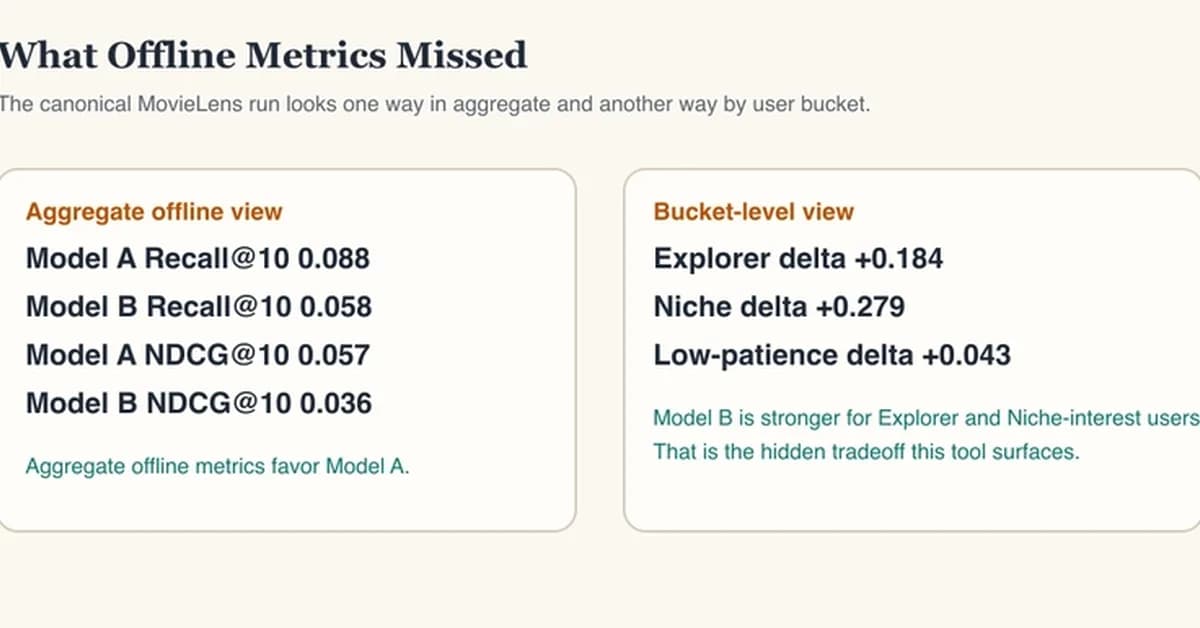
The article discusses the limitations of relying solely on offline evaluation metrics for recommendation systems and introduces an additional layer of evaluation: synthetic population testing. The main points are:
-
Limitations of Offline Evaluation: While traditional offline evaluation metrics provide a useful first screen, they often fail to capture the heterogeneity in user preferences and experiences that different recommender models can offer.
-
Introduction of Synthetic Population Testing: This approach involves evaluating recommendation systems against predefined behavioral lenses or synthetic populations rather than relying solely on aggregate metrics. It aims to make hidden tradeoffs visible before a model is deployed, helping teams understand who benefits from the new system and who might be negatively impacted.
-
Current Artifact: The author presents a small public evaluation harness that compares two models (baseline vs candidate) through multiple behavioral lenses. This tool provides segment-level and trajectory-level insights into how different user segments experience each model differently.
-
Evaluation Stack:
- Layer 1: Standard Offline Evaluation
- Remains the foundational layer for initial assessment.
- Layer 2: Segment-Aware & Trajectory-Aware Diagnostics
- Adds explicit behavioral lenses and short trajectory diagnostics to provide deeper insights into model performance across different user segments.
- Layer 1: Standard Offline Evaluation
Read the full article at DEV Community
Want to create content about this topic? Use Nemati AI tools to generate articles, social posts, and more.

![[AINews] The Unreasonable Effectiveness of Closing the Loop](/_next/image?url=https%3A%2F%2Fmedia.nemati.ai%2Fmedia%2Fblog%2Fimages%2Farticles%2F600e22851bc7453b.webp&w=3840&q=75)