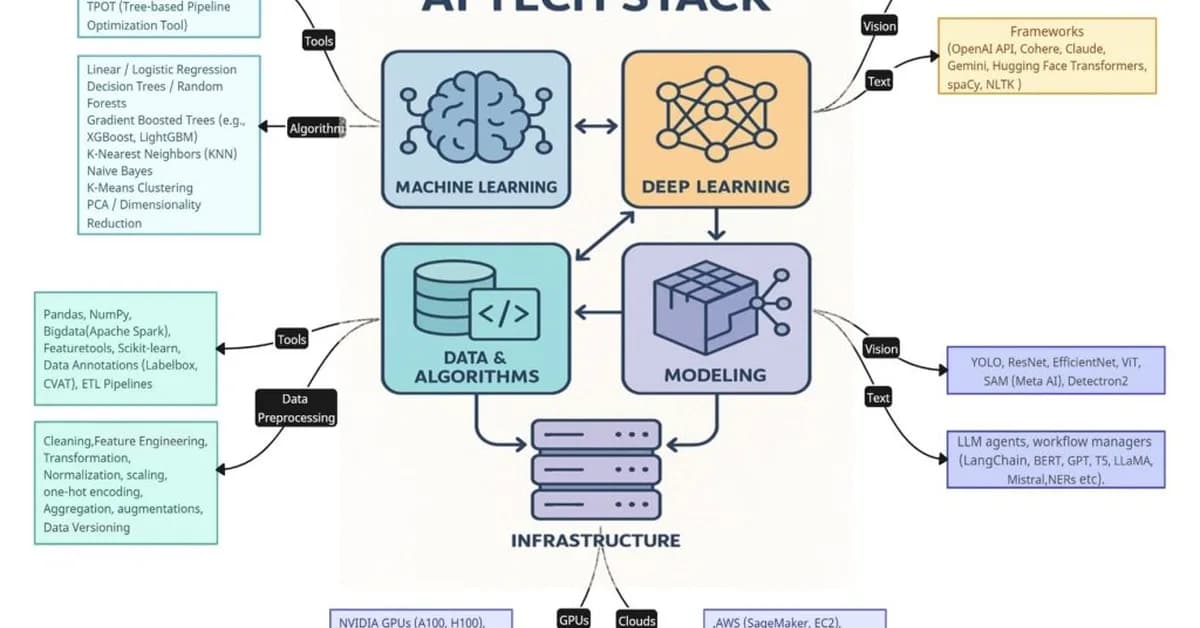
This guide provides a comprehensive overview of building an AI stack for practical applications, covering the essential layers from data retrieval to model integration and beyond. Here's a summary of key points and actionable steps:
Key Points
-
Understanding the Layers:
- Data Retrieval: Use vector databases like Qdrant or Pinecone to store embeddings.
- Model Integration: Choose between cloud APIs (e.g., Anthropic, Cohere) for large models or local models (e.g., LLaMA, GPT-NeoX).
- Orchestration: Combine data retrieval and model integration using frameworks like LangChain.
-
Building an AI Stack:
- Start with a simple task: summarize meeting notes, generate SQL queries from natural language, or classify support tickets.
- Use RAG (Retrieval-Augmented Generation) to ground the model in your specific data.
- Implement logging and monitoring for continuous improvement.
-
Navigating Pitfalls:
- Cost Management: Cache common queries, set strict token limits, and use tiered models.
- Latency: Optimize chunking, use quantized models, and implement streaming responses.
- **
Read the full article at DEV Community
Want to create content about this topic? Use Nemati AI tools to generate articles, social posts, and more.
20
Contents

Ali NematiWritten by Ali
![[AINews] The Unreasonable Effectiveness of Closing the Loop](/_next/image?url=https%3A%2F%2Fmedia.nemati.ai%2Fmedia%2Fblog%2Fimages%2Farticles%2F600e22851bc7453b.webp&w=3840&q=75)