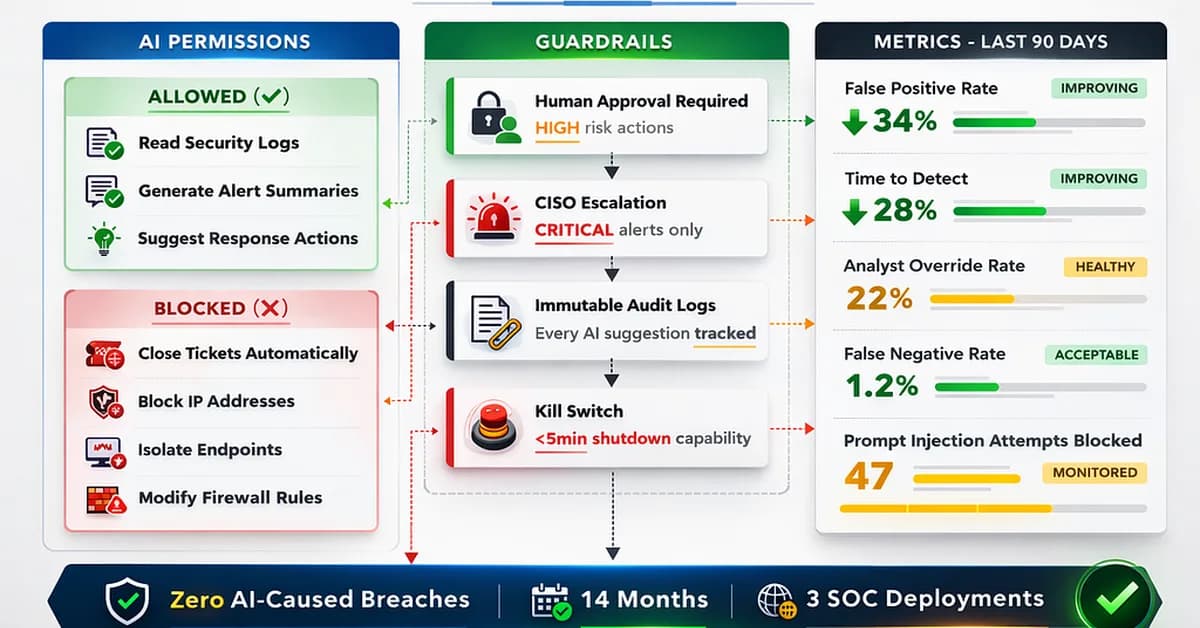
Agentic Identity Guardrails: Architecture and Implementation
To effectively manage the security risks associated with an agentic ecosystem, it's crucial to establish a robust framework that includes inventory management, risk assessment, governance, and continuous monitoring. Below is a detailed architecture for implementing such guardrails.
Layer 1: Inventory and Classify Every Agent
The first step in securing your agentic environment is to have a complete and accurate inventory of all AI agents. This involves discovering and classifying every agent based on its type, permissions, activity metrics, and governance status.
python1from dataclasses import dataclass 2from typing import List, Dict, Optional, Set, Enum 3import requests 4 5# Define the types of agents 6class AgentType(Enum): 7 WORKFLOW_AUTOMATION = "workflow_automation" # Zapier, Make, n8n 8 AI_COPILOT = "ai_copilot" # ChatGPT plugins, Claude MCP 9 SAAS_BOT = "saas_bot" # Slack bots, Teams apps 10 RAG_PIPELINE = "rag_pipeline" # Document indexers, knowledge bases 11 CUSTOM_AGENT = "custom_agent" # Internally built agents 12 SH 13 14[Read the full article at Towards AI - Medium](https://pub.towardsai.net/the-air-gapped-chronicles-the-agentic-ecosystem-when-your-ai-agents-become-your-loudest-shadow-b0fa58f136d0?source=rss----98111c9905da---4) 15 16--- 17 18**Want to create content about this topic?** [Use Nemati AI tools](https://nemati.ai) to generate articles, social posts, and more.
8
Contents

Ali NematiWritten by Ali
![[AINews] The Unreasonable Effectiveness of Closing the Loop](/_next/image?url=https%3A%2F%2Fmedia.nemati.ai%2Fmedia%2Fblog%2Fimages%2Farticles%2F600e22851bc7453b.webp&w=3840&q=75)