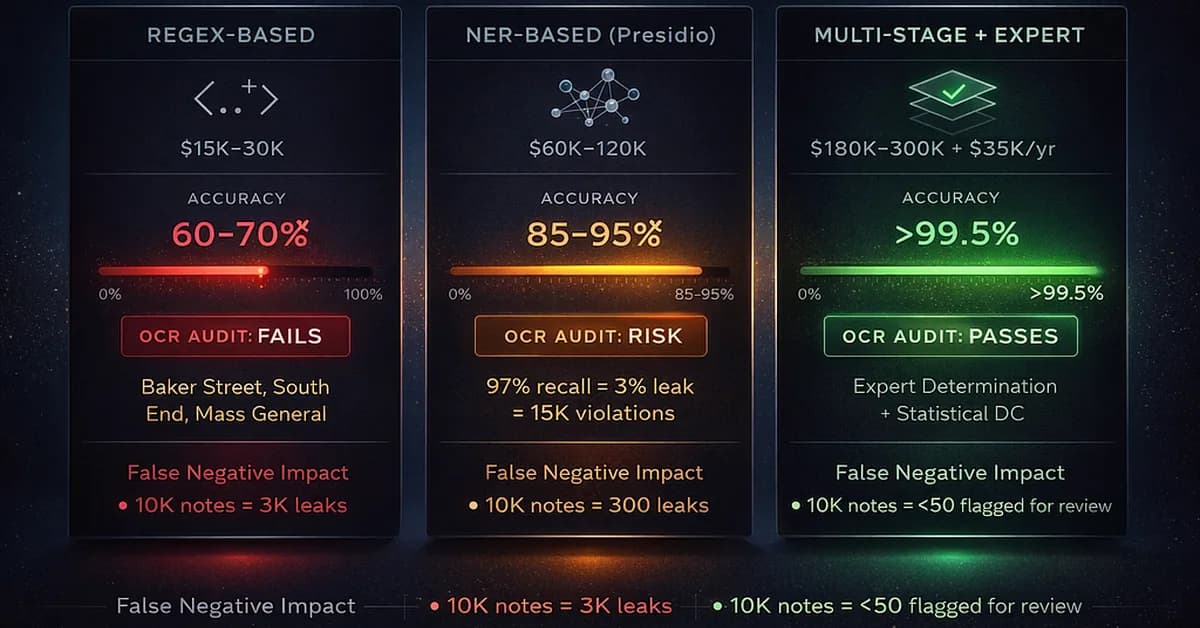
<p>The multi-stage de-identification pipeline described in the article is designed to meet stringent compliance requirements for sending sensitive data to external APIs like Azure OpenAI. This approach ensures that data meets the "very small risk" standard required by OCR (Office for Civil Rights) audits under HIPAA regulations. Here's a breakdown of each stage:</p>
<h4>Stage 1: Safe Harbor</h4>
<ul>
<li><strong>Purpose:</strong> Remove all 18 identifiers listed in the HIPAA Safe Harbor provision.</li>
<li><strong>Techniques Used:</strong> NER (Named Entity Recognition) for detecting entities like names, locations, dates, and medical-specific identifiers. Custom recognizers are used to detect additional medical-related identifiers such as MRNs, account numbers, device identifiers, etc.</li>
<li><strong>Output:</strong> Anonymized text with consistent tokens replacing each identifier type (e.g., "[PERSON]", "[LOCATION]", "[DATE]").</li>
</ul>
<h4>Stage 2: Quasi-Identifier Suppression</h4>
<ul>
<li><strong>Purpose:</strong> Remove quasi-identifiers that could enable re-identification.</li>
<li><strong>Techn
Read the full article at Towards AI - Medium
Want to create content about this topic? Use Nemati AI tools to generate articles, social posts, and more.
4

Ali NematiWritten by Ali
![[AINews] The Unreasonable Effectiveness of Closing the Loop](/_next/image?url=https%3A%2F%2Fmedia.nemati.ai%2Fmedia%2Fblog%2Fimages%2Farticles%2F600e22851bc7453b.webp&w=3840&q=75)