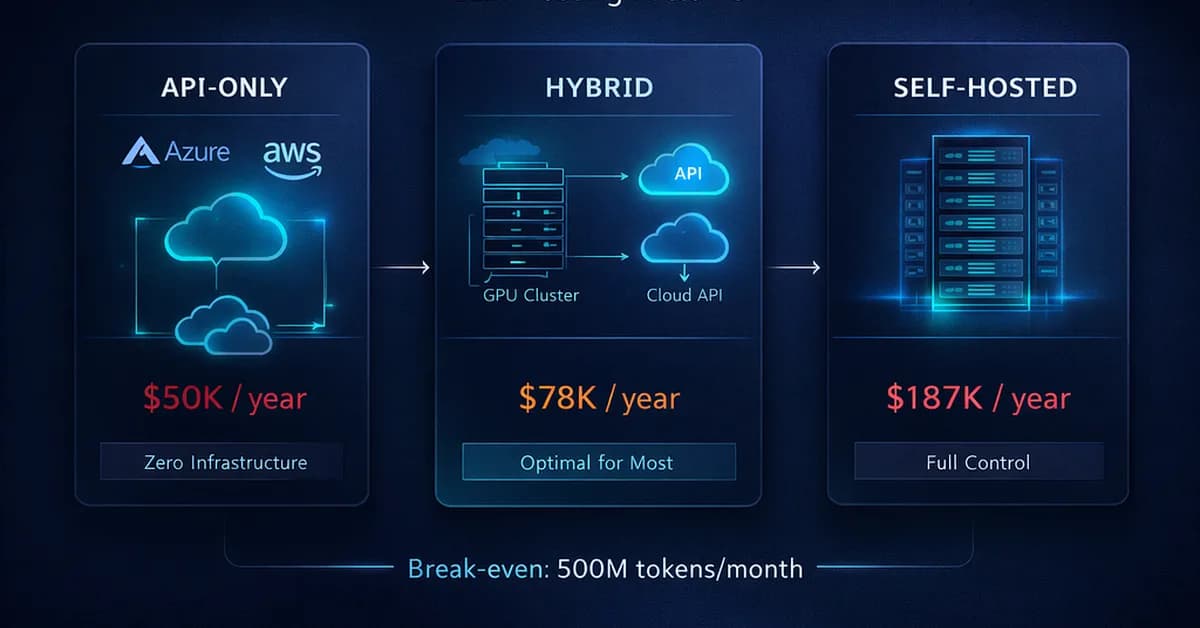
Summary and Key Insights
The document provides a detailed analysis of the economics and technical considerations for deploying large language models (LLMs) in healthcare settings, specifically focusing on hybrid architectures that combine self-hosted clusters with cloud-based API services. Here are the key insights:
-
Cost Analysis:
- Self-hosting an LLM can be significantly cheaper per token compared to using a cloud-based API.
- However, underutilized self-hosted infrastructure leads to high costs and inefficiencies.
-
Hybrid Architecture Benefits:
- Combining self-hosted clusters with APIs allows organizations to leverage the strengths of both approaches: cost efficiency for predictable workloads and flexibility for sporadic or experimental tasks.
- The hybrid approach optimizes resource utilization, reducing overall expenses while maintaining performance and scalability.
-
Routing Logic:
- Workload characteristics such as token volume, variance in usage, latency requirements, need for fine-tuning, and whether the task is experimental determine the optimal hosting pattern (self-hosted, API, or hybrid).
- The provided Python code outlines a decision tree to route requests based on these criteria.
-
Failover Mechanism:
- A robust failover mechanism
Read the full article at Towards AI - Medium
Want to create content about this topic? Use Nemati AI tools to generate articles, social posts, and more.
2
Contents

Ali NematiWritten by Ali
![[AINews] The Unreasonable Effectiveness of Closing the Loop](/_next/image?url=https%3A%2F%2Fmedia.nemati.ai%2Fmedia%2Fblog%2Fimages%2Farticles%2F600e22851bc7453b.webp&w=3840&q=75)