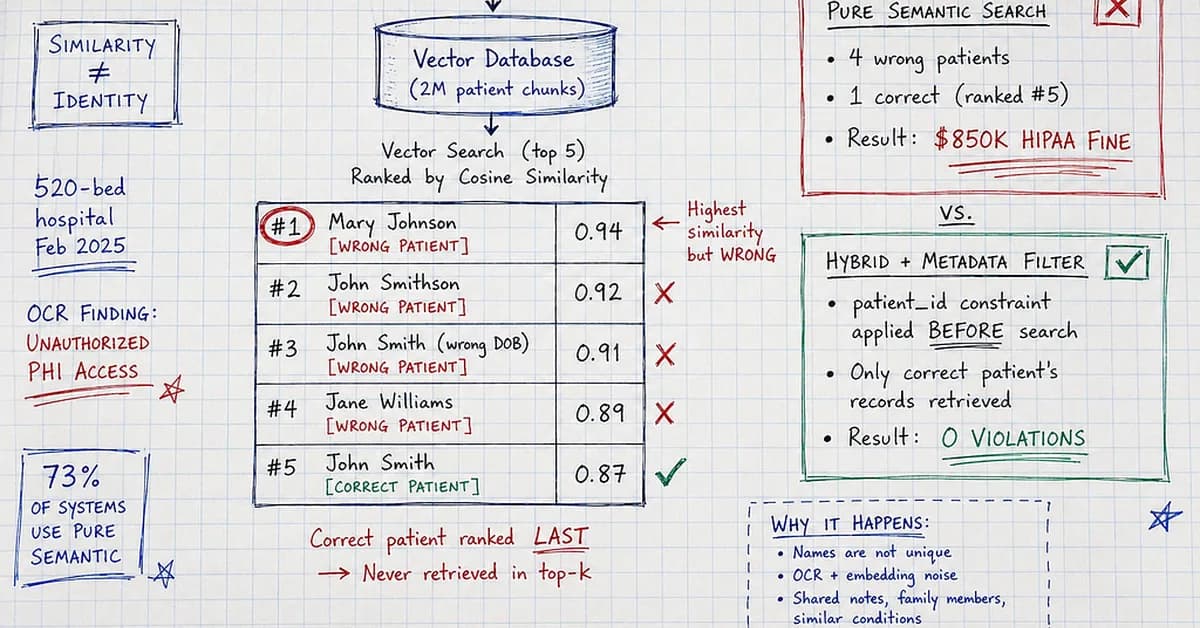
It's clear that the two patterns you've described—Pure Semantic Search and Hybrid Semantic + Keyword Search—are both prone to significant flaws when it comes to ensuring document correctness in retrieval systems like RAG (Retrieval-Augmented Generation). These issues can lead to serious consequences, especially in sensitive domains such as healthcare where patient privacy and accurate medical information are paramount.
Pattern 1: Pure Semantic Search
Why This Fails:
- No Patient Identity Validation: The system retrieves documents based solely on semantic similarity without verifying that the retrieved documents belong to the correct patient.
- Similarity ≠ Relevance: High semantic scores do not guarantee relevance or correctness of the document in terms of metadata like patient ID, date, and category.
- Lack of Metadata Filtering: There's no mechanism to restrict search results based on specific metadata constraints.
Pattern 2: Semantic + Keyword Hybrid Search
Why This Fails:
- No Patient Identity Validation: Similar to Pure Semantic Search, this pattern doesn't validate that the retrieved documents belong to the correct patient.
- Keyword Matching Issues: While BM25 helps with keyword matching, it can still lead to incorrect matches if the query contains terms present in multiple documents (e
Read the full article at Towards AI - Medium
Want to create content about this topic? Use Nemati AI tools to generate articles, social posts, and more.
112
Contents

Ali NematiWritten by Ali