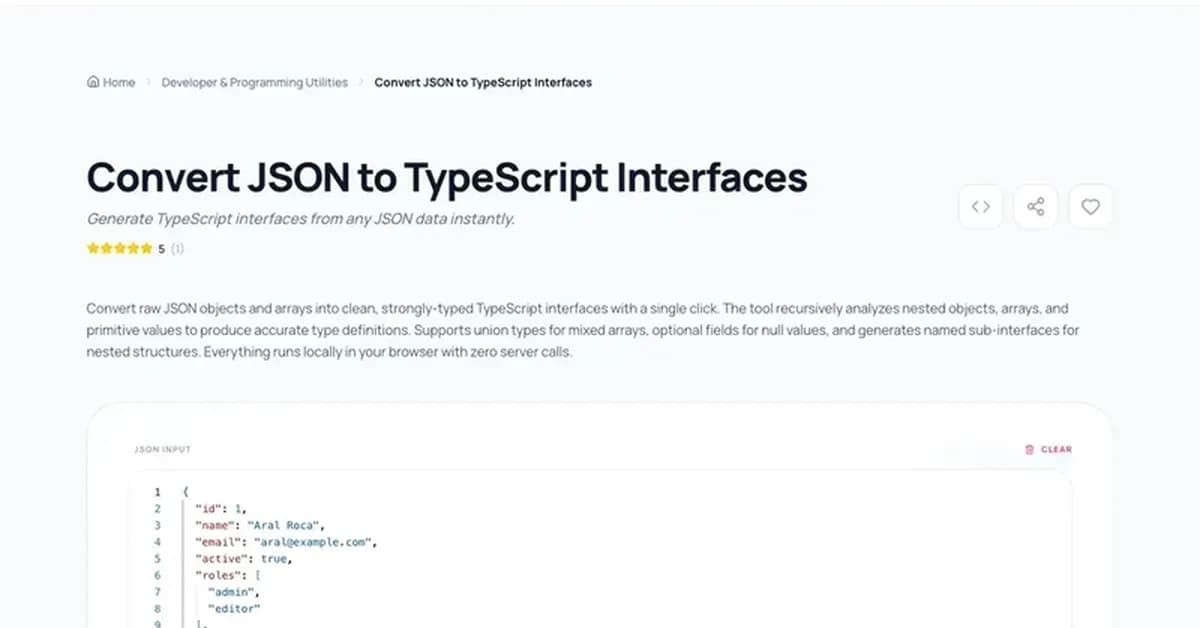
The article discusses the process of generating TypeScript types from JSON responses, focusing on three approaches: manual typing, using Large Language Models (LLMs), and deterministic conversion. The key points are:
-
Manual Typing:
- Involves writing TypeScript interfaces by hand.
- Pros: Full control over type definitions.
- Cons: Time-consuming and error-prone, especially for complex JSON structures.
-
Using LLMs (Large Language Models):
- Tools like chatbots or online converters that generate types based on natural language input.
- Pros: Faster than manual typing.
- Cons: Inconsistent results due to the probabilistic nature of AI-generated code; may require significant editing and validation.
-
Deterministic Conversion:
- A tool that converts JSON directly into TypeScript interfaces without randomness or guesswork.
- Pros: Fast, consistent, and always correct for the provided sample data.
- Cons: Requires manual refinement for optional fields, string enums, date parsing, etc., but these adjustments are straightforward.
Key Benefits of Deterministic Conversion:
- Speed: Quick generation of TypeScript interfaces from JSON.
- Correctness: Ensures that types match the provided JSON sample
Read the full article at DEV Community
Want to create content about this topic? Use Nemati AI tools to generate articles, social posts, and more.
8
Contents

Ali NematiWritten by Ali
![[AINews] The Unreasonable Effectiveness of Closing the Loop](/_next/image?url=https%3A%2F%2Fmedia.nemati.ai%2Fmedia%2Fblog%2Fimages%2Farticles%2F600e22851bc7453b.webp&w=3840&q=75)