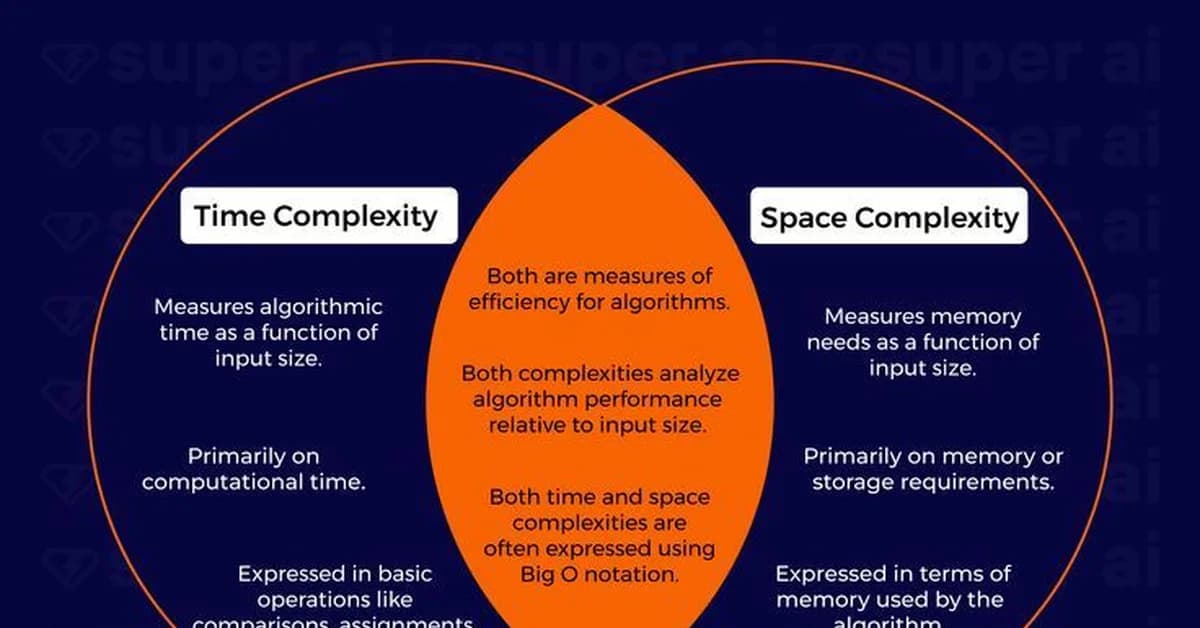
It looks like the content was cut off, but I'll summarize and provide additional context for each of the complexities mentioned in your document:
Summary of Complexity Classes
-
O(1) - Constant Time
- The number of operations is constant regardless of input size.
- Example: Accessing an element in an array by index.
-
O(log n) - Logarithmic Time
- The number of operations grows logarithmically with the input size.
- Example: Binary search on a sorted list.
-
O(n) - Linear Time
- The number of operations is directly proportional to the input size.
- Example: Iterating through an array once.
-
O(n log n) - Linearithmic Time
- Slightly worse than linear time but much better than quadratic time.
- Example: Merge sort, quicksort (average case).
-
O(n^2) - Quadratic Time
- The number of operations grows quadratically with the input size.
- Example: Bubble sort, nested loops.
-
O(2^n) - Exponential Time
- The number of operations doubles with each additional element in the
Read the full article at DEV Community
Want to create content about this topic? Use Nemati AI tools to generate articles, social posts, and more.
2
Contents

Ali NematiWritten by Ali
![[AINews] The Unreasonable Effectiveness of Closing the Loop](/_next/image?url=https%3A%2F%2Fmedia.nemati.ai%2Fmedia%2Fblog%2Fimages%2Farticles%2F600e22851bc7453b.webp&w=3840&q=75)