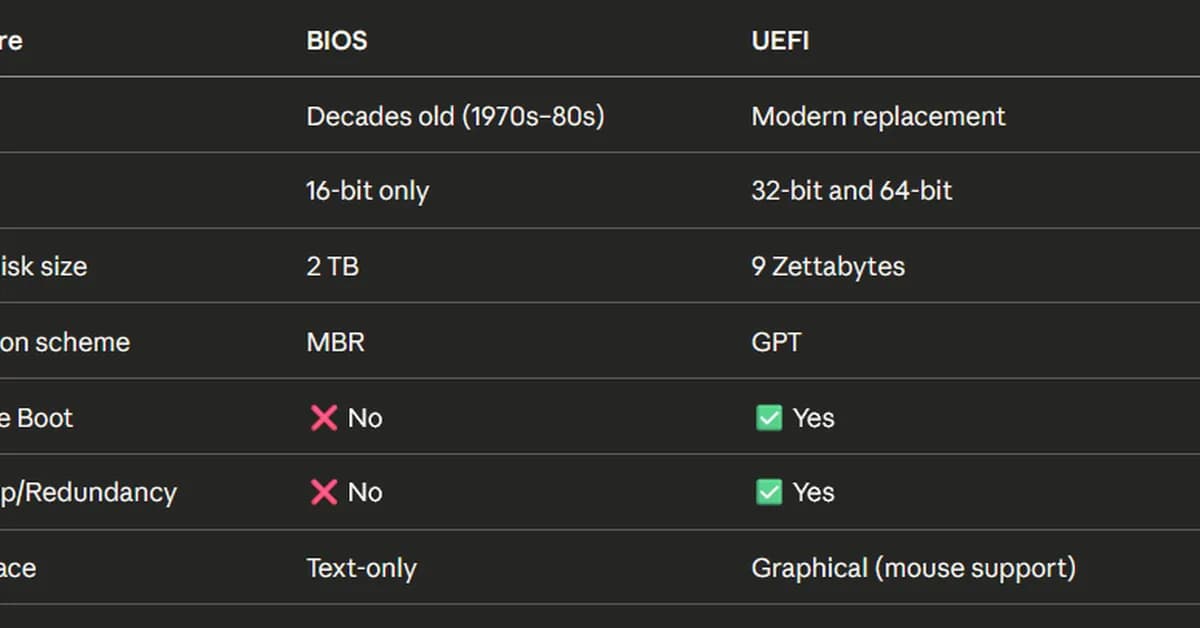
Let's break down the structure of MBR (Master Boot Record) and its components, focusing on how it functions to load an operating system during a computer startup.
Structure of MBR
The MBR occupies exactly 512 bytes at the very beginning of a disk (starting from sector 0). It can be divided into two main sections:
-
Bootstrap Code (Bytes 0–445)
- This section contains code that is executed by BIOS when the computer starts up.
- Its primary job is to read and execute the second-stage bootloader, which resides in one of the four partitions marked as bootable.
-
Partition Table (Bytes 446–509)
- The partition table consists of 16-byte entries for each of the four possible partitions.
- Each entry contains crucial information about a single partition:
- Boot indicator: A flag indicating if this partition is bootable.
- Starting CHS address (Cylinder, Head, Sector): Where the partition starts on the disk.
- System ID: An identifier for the file system type (e.g., 07h for NTFS).
- Ending CHS address: Where
Read the full article at InfoSec Write-ups - Medium
Want to create content about this topic? Use Nemati AI tools to generate articles, social posts, and more.
Views194
On this page

Ali NematiBlogUI.author_articles