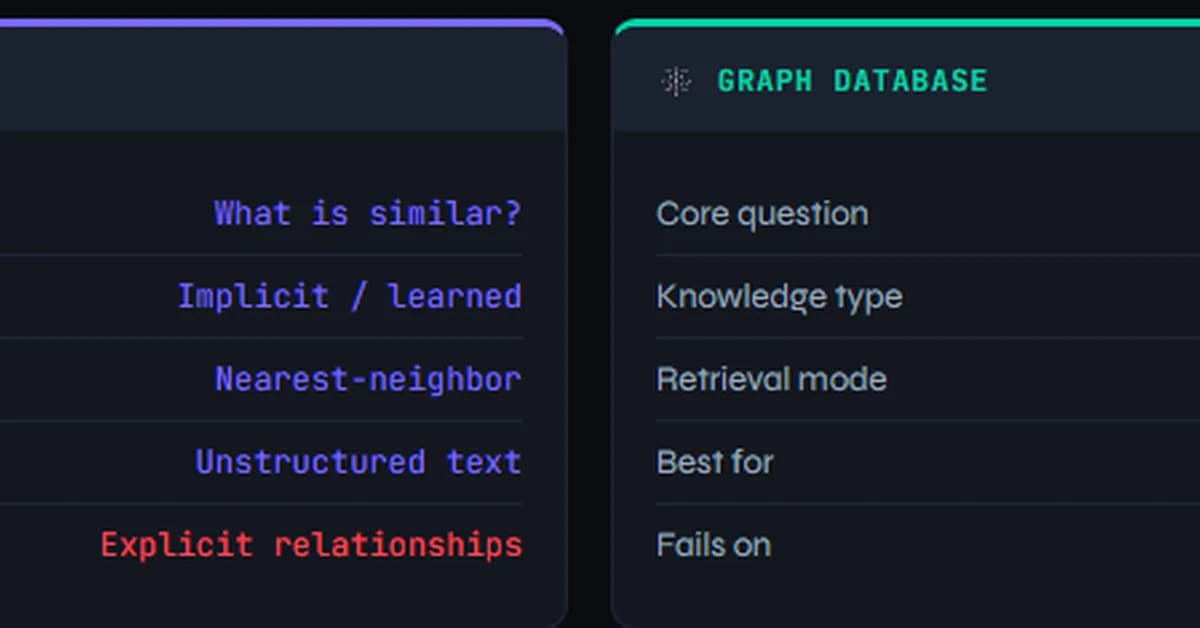
The decision between using a graph database and a vector (semantic) database hinges on whether your use case revolves around implicit relationships derived from data patterns versus explicit connections that need to be manually defined. Here's the simplified framework for choosing:
Default to Vector Database:
- Semantic Search: When you're dealing with unstructured content like text documents, articles, or web pages and want to find semantically similar items.
- Document Retrieval: For applications where users query a large corpus of documents based on context rather than exact keywords.
- RAG (Retrieval-Augmented Generation): In scenarios where you need to retrieve relevant information from a document store to enhance the response generated by a language model.
Default to Graph Database:
- Fraud Detection: When identifying complex patterns and relationships between entities, such as synthetic identities or fraudulent activities.
- Knowledge Graphs: For applications that require capturing explicit relationships between entities (e.g., people, companies, products) and their attributes.
- Recommendation Systems: Especially when recommendations are based on relationship strengths rather than similarity scores derived from embeddings.
Key Considerations:
- Implicit vs Explicit Relationships:
- Vector DBs: Understand implicit relationships through context analysis
Read the full article at Towards AI - Medium
Want to create content about this topic? Use Nemati AI tools to generate articles, social posts, and more.
2
Contents

Ali NematiWritten by Ali
![[AINews] The Unreasonable Effectiveness of Closing the Loop](/_next/image?url=https%3A%2F%2Fmedia.nemati.ai%2Fmedia%2Fblog%2Fimages%2Farticles%2F600e22851bc7453b.webp&w=3840&q=75)